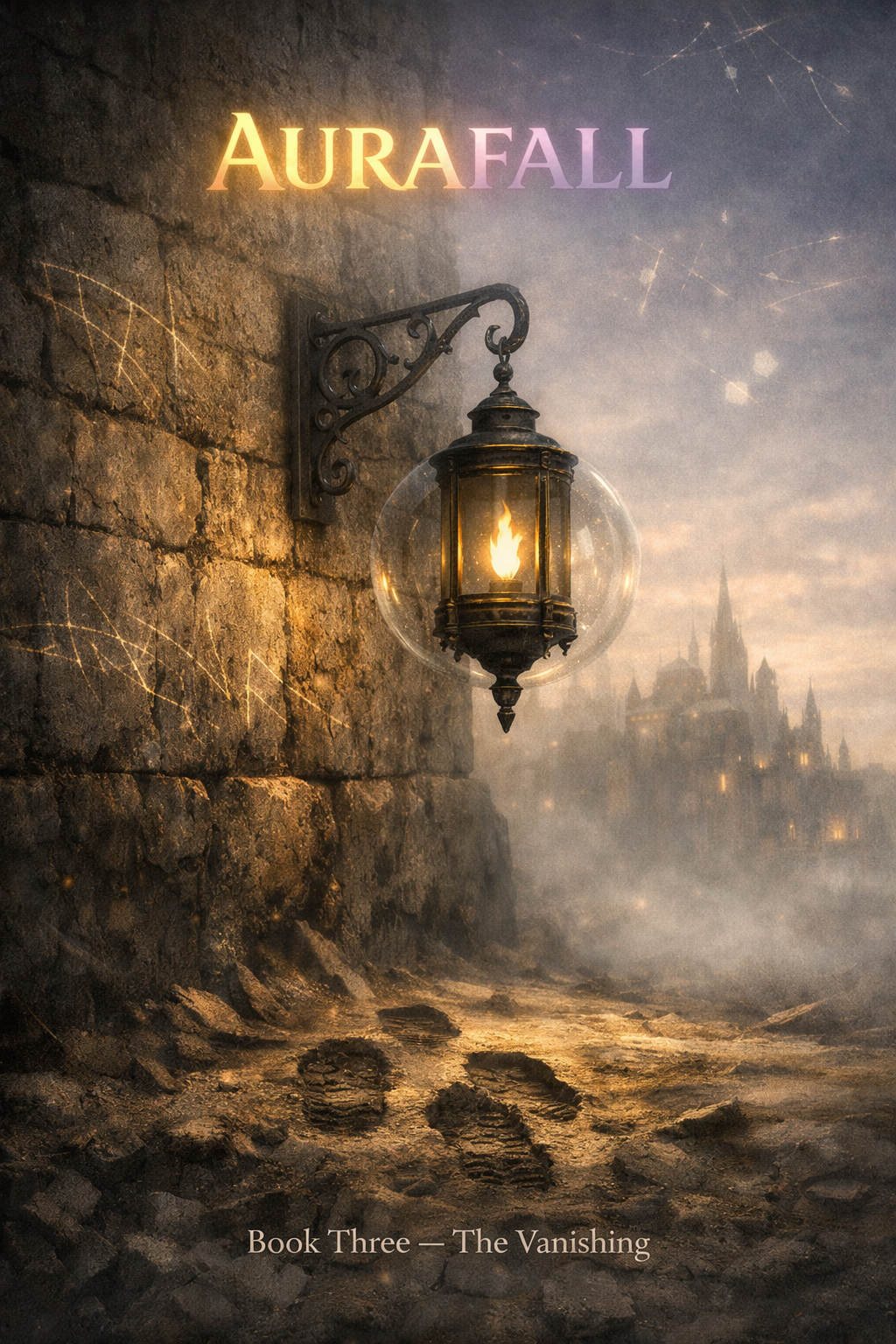
People disappear without dying. Ryan cracks the pattern of it — and finds himself in the pattern. Dave vanishes mid-sentence. His tea is still warm.
← All BooksThe Auralight has always flickered.
Candles gutter in rooms where no window is open. Lanterns sway on hooks driven deep into stone. Torches catch a wind that isn't there and lean sideways, painting the walls with the long shadows of people who have already passed. No one thinks much of it. The light has always had moods.
Wielders feel it the way they feel weather — a pressure behind the ribs, a faint warmth at the base of the skull. Sometimes it beats steady, a second heartbeat laid beneath the first. Sometimes it quickens, all nerves and flutter, like a bird trapped in a chimney. Sometimes it pulls back, goes shy, curls into itself the way an animal does before a storm. These are not alarming things. They are the habits of something alive.
Living things move.
But this is different.
This is the light forgetting.
It starts small, the way all the worst things do.
A lamp in the lower district of Eldoria that simply stops responding. Not blown out. Not starved of oil. The wick is fine, the reservoir full, the glass uncracked. A man holds a match to it three times and it catches, burns, gives off light in the ordinary way a flame gives off light — but the room stays dim. Not dark. Dim. As though the brightness is there but has forgotten what it is supposed to illuminate. He calls the landlord. The landlord calls it a draft.
A forge fire in the Seventh Quarter burns all morning without warmth. The smith, a man named Pol who has worked iron for thirty years, stands with his hands extended over the coals and feels nothing. He checks the bellows. He checks the flue. He adds fuel until the fire is roaring, white-hot, climbing nearly to the hood, and his palms remain cold. The iron will not soften. He shuts the forge at noon and tells his apprentice they’ll try again tomorrow. He does not say what he is thinking, which is that the fire looked at him the way a window looks at a room — present, transparent, and completely indifferent.
A child reaches for her mother’s hand crossing a bridge in the merchant district and finds it cold. Not cold the way hands get in winter. Cold the way stone is cold when it has never been warm. The child pulls away and says nothing about it because she is four and does not have the language for what she has just felt.
The light is present. It simply isn’t there.
These things happen across the city in the space of a single week, and no one connects them because no one is looking. They are small. They are separate. They are the kind of wrong that folds easily into the ordinary, the way a single off note folds into a song you already know by heart.
Rosie notices it first because the earth tells her.
She is walking the eastern wall at dawn, which she does most mornings when sleep won’t hold her. The wall is old — older than the city it protects, older than the name the city carries — and she likes the way it feels beneath her boots. Steady. Dense. Full of its own slow memory. She has always understood stone better than people. Stone does not perform. It simply is, with a patience that makes human certainty look like panic.
She is halfway along the upper parapet when the soil beneath her feet shifts its tenor.
Not an earthquake. Not a tremor. If it were either of those she would know what to do — she has learned the language of the earth’s violence. This is not violence. This is something quieter. Something going absent in the lattice below, the way a tooth goes quiet right before it starts to hurt.
She stops mid-step.
She stands there, one foot slightly forward, her weight unevenly distributed, and she listens with her Earthshaping — the part of herself that has nothing to do with ears. The lattice — the humming architecture of andesite and deep time that runs beneath everything — has a gap in it. Not a crack. A gap. A place where something was and now isn’t. A held breath in the long exhalation of the ground.
She kneels. Presses her palm flat to the stone.
The wall gives back nothing.
Not silence. Silence is a presence — the decision of a thing to be still. This is absence. The minerals are there, the andesite, the feldspar and quartz. But the thing that connects them — the thing that makes stone stone and not just powder waiting to fall apart — has pulled back. Forgotten itself.
She holds her hand there for a long time.
The sun comes up behind her and her shadow stretches along the parapet like something trying to leave. Below, the city begins its morning noise — carts on cobblestone, a dog, someone shouting about the price of salt. Ordinary sounds. Ordinary day. Nothing to suggest that the ground beneath all of it has started to come loose from itself in a way that no one can see.
She doesn’t mention it to anyone that morning.
She tells herself it was subtle. She tells herself it could be nothing — a fluctuation, a settling, the deep earth doing whatever the deep earth does when no one is paying attention. She tells herself she needs more certainty before she says something that might alarm people who are only just beginning to feel safe again.
She tells herself a lot of things.
The truth, which she will not admit for weeks, is simpler and worse: she is afraid that if she says it out loud, it will become real. That the gap in the lattice will hear its own name and widen.
So she goes to breakfast. She sits across from Erica, who is talking about the eastern patrol ranges with her hands, sketching the shape of terrain and tree lines with sharp little gestures as though the air between them is a map. She nods at the right moments. She eats bread that tastes like bread and drinks water that tastes like water and does not say: Something is leaving. Something beneath us is leaving and I don’t know where it is going.
Erica finishes her tea and stands, already shifting as she turns — her shoulders narrowing, her arms drawing tight against her sides, her coat folding into something that catches the light differently. By the time she reaches the window she is a kestrel, small and sharp-eyed, and she drops from the sill without a sound. Rosie watches her go and says nothing about that either.
She does not say: The wall felt like a body after the heart stops. Still warm. Still shaped like a person. But empty in the way that matters most.
She does not say any of this because she is steady, because she is the one people look to when the ground shakes, and the ground is not shaking. The ground is doing something much worse than shaking. The ground is going quiet.
And she says nothing.
She will spend the rest of her life regretting that silence.
Not because speaking would have stopped what was coming. It wouldn’t have. The forgetting had already begun — threaded through the lattice, settled into the space between the flame and its warmth like a film of ice on still water. Nothing she could have said at breakfast would have changed the shape of what followed.
But she would have been first. She would have been the one who said it. And there is a difference — small, perhaps, but real — between a disaster that arrives unannounced and one that someone tried to name. Not because the naming fixes anything. Because it means someone was paying attention.
She will think about this on the worst nights, later. She will lie awake and feel the lattice beneath her — thinner now, so much thinner — and she will replay that morning on the wall. The sunrise. The cold stone. The gap. She will open her mouth in the memory and try to make herself speak, and the memory will not let her, because that is not what happened.
What happened is she stood up. Brushed the grit from her knees. Walked the rest of the wall in silence.
Below her, the city moved through its ordinary morning. The Auralight hung in the air the way it always did — golden, diffuse, warm as a hand on the back of your neck. You could look at it and see nothing wrong. You could stand in it and feel its warmth and believe, fully and without reservation, that it would be there tomorrow.
But underneath it, something had started to thin.
Like paint over rust. Like a room after someone leaves it.
Like the moment just before you realize the music has stopped — when the silence is still wearing the shape of the song, and you haven’t yet understood that what you’re hearing is nothing at all.
The first confirmed disappearance they could date precisely was the caravan on the Lowland Road. Tanya found it at the third mile marker, three hours after leaving Eldoria at dawn.
She had not announced her departure.
She had oiled the door herself three nights earlier, working the hinges with a rag until they gave without sound. At the time she told herself she was being practical. Doors should not squeak. It was maintenance, not preparation. She hadn’t admitted to herself why until she was already through it, her pack cinched tight and the walls of Eldoria shrinking behind her in the grey pre-light, and even then the admission came not as a thought but as a loosening in her chest, the particular relief of something finally matching its own shape.
The Order would hold. Kirsten would hold it.
These were facts, not consolations, and Tanya needed the difference between them to be clear before she could leave. A consolation was something you told yourself to make departure bearable. A fact was something that remained true whether you stayed or went. Kirsten’s competence did not require Tanya’s presence to confirm it. The Order’s structure did not depend on any single person standing inside it. If it did, it was not a structure. It was a habit.
Tanya did not leave because she thought things would fall apart. She left because she needed to see the road with her own eyes, and no amount of reports carried in by traders and refugees could substitute for that.
She expected the road. Hard-packed earth, wheel ruts from late-season traffic, the Lowlands stretching flat and featureless toward the eastern ridgeline. She expected solitude. She had planned for it.
She did not expect the caravan.
It sat just past the third mile marker, three wagons drawn into a loose crescent off the road’s southern edge. The kind of arrangement travelling merchants made when they stopped for the night—defensive without being fortified, close enough for conversation, open enough for airflow. Standard positioning. Two of the wagons still had their wheels turned into the ruts, as though they had been guided off the road mid-roll and simply stopped.
A fire ring at the centre. Ash that hadn’t scattered.
Tanya stopped walking. She stood at the edge of the crescent and listened. Wind through grass. Nothing else. No creak of harness leather. No murmur of voices. No animals.
The packs were open. Three of them, laid out beside the nearest wagon, their contents half-sorted—dried fruit in one pile, rolled cloth in another, a pouch of something dark that might have been tea. The sorting had stopped mid-action. Not interrupted. Not abandoned in haste. Just stopped, the way a sentence stops when the speaker forgets what they were saying.
A pot hung over the fire ring on an iron tripod, its contents long cold. Some kind of stew, greyed and congealed. A wooden spoon rested across the pot’s rim, perfectly balanced.
Someone’s boot—just one—placed neatly beside a wagon wheel. Set down deliberately, the laces loosened, the tongue folded back as though someone had eased their foot out and meant to return to it. The other boot was nowhere.
Tanya walked the perimeter. Then she walked it again.
This looked like none of the things she knew. Not hasty departure—the goods were too valuable to leave, and nothing was trampled. Not struggle—nothing overturned, no marks in the earth, no blood. Not choice—no one walks away from their own boots. This looked like people who had simply ceased to be where they were.
She crouched beside the fire ring and pressed two fingers into the ash.
Faintly warm. Not from fire—the coals were long dead. Warm the way stone is warm after a full day of sun, except there had been no sun. The morning was overcast, had been overcast since before dawn. The warmth had no source she could identify. It was simply there, residual, like the heat a body leaves in bedsheets after rising.
She wiped her fingers on her trousers and stood.
Then she did nothing for a long time, which was how she thought. She stood with her weight on both feet and her arms loose at her sides and she let the details accumulate without sorting them. Sorting was a second step. The first step was receiving.
A child’s toy half-buried in the dirt beside the nearest wagon. Carved wood, some kind of animal—a horse, maybe, or a dog. Small enough to fit in a fist. It had been dropped, not placed. The earth around it was undisturbed.
A letter, unfinished, weighed down by a stone on the tailgate of the middle wagon. She did not read it. She noted its existence. The handwriting was small and careful, the ink unfaded. Recent.
A harness buckled to nothing. It hung from the front post of the third wagon, fastened and cinched as though an animal still stood inside it. The leather was taut. Whatever had worn it had not slipped free. The harness had not been opened. The animal had simply stopped being there.
Tanya crouched again, this time at the edge of the crescent where the dirt was softest.
The footprints were wrong.
She had nearly missed them. They were ordinary in shape—boot soles, bare feet, the small rounded impressions of a child. The kind of prints any camp would leave. But they didn’t trail away. Every set she found ended where it began. No departure lines. No paths leading out of the crescent toward the road or the fields or the treeline. The prints went to their positions and then simply existed there, pressed into the earth with an unusual depth.
She knelt closer. Pressed her thumb into the heel of the nearest print.
Deep. Too deep. A boot pressed into soft earth by the weight of a standing person should sink perhaps a quarter inch. These were nearly an inch deep, the edges sharp, the compression even. As though the people had been pushed down—through the ground rather than walking on it. As though the earth had tried to swallow them and managed only the impression of their feet.
Down instead of away.
She pulled her thumb free. The soil held its shape perfectly. It did not crumble back into the hollow she’d touched. It stayed exactly as it was, rigid, certain, like a mould from which the original had been extracted.
She considered her options.
She could return to Eldoria. Three hours back, report in person, watch the information move through the Order’s careful channels. Kirsten would listen. Kirsten would act. But the acting would take time, because the Order moved deliberately, and deliberately was not what this required.
She could press forward. East, toward the ridge, where the road bent north and the next settlements began. If this had happened here, at the third mile marker, it had happened elsewhere. She was certain of this the way she was certain of weather—not from evidence but from pressure, the particular weight behind her eyes that preceded storms.
Instead she did both.
She tore a page from her own notebook and wrote quickly, standing against the tailgate of the middle wagon beside the unfinished letter she had not read. Her handwriting was not small or careful. It was fast and blunt, the letters leaning forward as though trying to arrive ahead of themselves.
Third mile marker. Lowland Road. Three wagons, no people. No signs of violence or departure. Footprints pressed down, not trailing. Ash still warm. Suggest immediate survey east along the road. Do not send fewer than four.
She folded the paper twice, marked it with Kirsten’s name, and left it weighted under a stone at the mile marker where the next eastbound rider would find it. It was not the fastest method. It was the most reliable. Tanya trusted reliability over speed. Speed was a promise. Reliability was a pattern.
The road ahead was empty.
Not quiet—the wind still moved, the grass still bent and recovered, a bird she couldn’t identify called twice from somewhere south and then stopped. The road was simply empty of people, which was not unusual for early morning on the Lowlands, except that now the emptiness carried a different quality. A precision to it. As though the absence were maintained.
Behind her, the caravan sat in perfect stillness. She did not look back. She didn’t need to. She knew exactly what it looked like—the wagons in their crescent, the cold pot, the single boot, the half-sorted packs. Everything waiting for people who would never come back to it.
The fire ring had gone cold by now. She was sure of that. Whatever residual warmth she’d felt in the ash had been fading even as she touched it, the last physical trace of something she did not yet have a name for.
Everything else remained exactly as it was.
That was the worst part, she thought. Not that they were gone. That nothing else changed when they left. The world had not rearranged itself around their absence. The pot still hung. The boot still waited. The letter still said whatever it said, half-finished, its last sentence pointing toward a future that had quietly ceased to exist.
The road stretched east. Tanya walked it.
There would be more. She was certain now, in the way certainty sometimes arrives—not as conclusion but as weight, settling into the body like cold water, filling the spaces between thought. Something was taking people. Not killing them. Not moving them. Simply removing them, the way you remove a word from a sentence and leave the grammar intact.
The sentence still reads. You just can’t remember what it was trying to say.
Eleven days without a full night’s sleep, and Kirsten had stopped pretending she was trying.
She stood at the window of her quarters in the upper residency, one hand flat against the cold stone of the sill. Below, the lower district spread in its usual arrangement of rooftops and alleyways and the pale geometry of the market square. The hour was somewhere past three. She didn’t check the clock anymore. She knew what time it was the same way she knew the weather — by the quality of the silence.
The lamps were lit. Most of them.
She counted. She always counted now. It had started as an idle thing, something to do with her eyes while her mind refused to settle. But idle things become rituals when the world starts behaving strangely, and rituals become data when you’re the kind of person Kirsten was.
Forty-three.
Last week, forty-seven. The week before that, she hadn’t been counting yet, which she now regretted with the precise, controlled frustration of a woman who understood that information only mattered when you had enough of it.
The missing lamps weren’t broken. She’d sent someone to check after the second night. The posts stood. The oil reservoirs were full. The wicks were intact and could be lit by hand and would burn — technically, physically, in every measurable way. But something had gone out of them. Not the flame. The presence of the flame. The quality that made lamplight more than combustion. She didn’t know how to write that in a report. She didn’t know how to say it without sounding like she’d lost her grip.
So she counted. Counting was safe. Counting was governance.
Forty-three. She pressed her forehead against the glass and watched the gaps in the light where the other four should have been.
Morning came the way mornings do when you haven’t slept — not as a beginning but as an accusation.
Kirsten was already at her desk when Marc arrived. He knocked twice, which meant he had something worth reading. One knock was routine. Three was urgent. Two meant: you’ll want to sit down for this, but nobody’s dead yet.
She waved him in without looking up from the supply ledger she wasn’t actually reading.
“Report from Tanya,” Marc said. He set the folded paper on the corner of her desk with the careful placement of a man who understood that documents had weight beyond their contents. “Came in on the eastern relay. Overnight.”
Kirsten picked it up. The paper was thin, travel-worn, folded once with Tanya’s characteristic efficiency. No wax seal. Tanya didn’t waste wax.
The report was short. A merchant caravan on the Lowland Road. Twelve people, last accounted for at dusk. By morning, gone. All of them. Wagons still loaded. Horses still tied. A cookfire with warmth still in its ashes. No signs of violence or struggle. No tracks leading away.
Tracks leading down.
Kirsten read that line twice. She turned the paper over as if expecting clarification on the back. There was none. That was Tanya — she reported what she observed and left interpretation to people who hadn’t been standing in the mud looking at impossible footprints.
“What do you make of it?” Kirsten asked.
Marc stood with his hands clasped behind his back, his posture as neutral as a blank page. “Twelve confirmed absent. No evidence of hostile engagement. Tanya’s assessment is thorough.”
“That’s not what I asked.”
“I know.” He met her eyes. “I don’t have an interpretation that fits the data. I’d rather give you nothing than give you something wrong.”
She respected that. She also wanted to throw the supply ledger at his head, but that was the insomnia talking.
“Sit down,” she said. He did.
She pulled the records herself. Not because she didn’t trust her staff, but because pattern recognition was a thing she did with her hands — shuffling papers, laying them side by side, seeing the shape that emerged when individual reports stopped being individual.
The Harwell family, south of the river. Farmers. Missed their market day three weeks ago. A neighbor rode out to check. The house was empty. The livestock were fed. The kitchen garden was still growing, orderly rows of runner beans climbing their stakes as if someone would be home any minute to harvest them. No one came home.
A border patrol on the northern ridge. Eight soldiers on a standard rotation. Two of them simply weren’t there at the next checkpoint. Their gear was found in position — packs set down, weapons stacked, as if they’d stepped away for a moment. The remaining six couldn’t say exactly when it happened. One of them described it as looking away and looking back. Like a blink that lasted too long.
A child in the village of Cairnwell. The mother’s testimony was the worst of them, not because it was dramatic but because it was so plain. She was playing in the yard. I went inside to get the washing. When I came back out she wasn’t there. No scream. No sound. The mother’s voice in the transcript was flat, factual, the way people speak when the thing that has happened to them is too large to fit inside an emotion.
Kirsten laid the reports across her desk. Five incidents. Six locations, if she counted the lamp posts. She looked for the pattern the way she’d been trained — geographically, temporally, by population density, by proximity to known auralight sources, by elevation, by trade route.
There was no pattern.
She checked again. Moved the papers. Drew lines on the map pinned to the wall behind her desk, connecting each site with thread she pulled from her sleeve hem because she couldn’t find the proper pins.
Random. Scattered. No center, no edge, no direction of spread.
That was the thing that made her set the thread down and stand very still for a moment. A pattern she could fight. Randomness meant it was everywhere. Or nowhere. Or both.
Marc returned after midday with the expression of a man carrying more weight than he’d left with.
“Eastern settlements,” he said, and placed three more reports on her desk.
She didn’t reach for them immediately. “How far east?”
“Thornfield. Millhaven. One unconfirmed from past the Ashridge border.”
“Past the border.” She let that settle. “So it’s not confined to Eldoria.”
“No.”
She picked up the reports. Same texture. Same absence. People who were there and then were not, leaving behind all the evidence of their lives except themselves. In Thornfield, a blacksmith’s forge found still hot, the hammer on the anvil mid-strike. In Millhaven, a schoolroom with lessons still chalked on the board and no students in the seats.
“How many total?” she asked.
“We don’t have reliable numbers yet.”
“Get them.”
Marc nodded. He didn’t ask why, or how, or what she planned to do with the information. He’d been in intelligence long enough to know that the first step in addressing any crisis was learning its actual size, and that most people skipped that step because the answer frightened them.
He paused at the door. “You should sleep.”
“Noted,” Kirsten said, in the tone that meant she would not.
Evening came. Kirsten returned to the window.
She counted the lamps.
Forty-one.
She stood there for a long time, watching the ones that remained. They burned well — steady, golden, doing exactly what lamps are supposed to do. Giving light. Giving the illusion that someone was tending them, that the city was cared for, that the basic mechanisms of civilization were functioning as designed.
But two more were gone. Not extinguished. Not broken. Just — absent. The fixtures existed. She could see them in the dark, iron posts standing like small monuments to something that used to be there. The oil existed. The wicks existed. Every physical component required for light was present and accounted for.
The light itself had simply stopped being.
It was the difference between a room with someone in it and a room where someone used to be. The architecture is the same. The furniture hasn’t moved. But you walk in and your body knows — something that belonged here is gone, and the space hasn’t figured out how to close around the absence yet.
Kirsten had governed through two wars. She’d held the Order together when it looked like it would break under the weight of the Harbinger, negotiated with people who wanted her dead, made decisions that kept others alive and cost her sleep for months after. She knew what a threat looked like. Threats had edges. Threats made demands. Threats could be mapped and measured and met with force or diplomacy or some calibrated combination of both.
This wasn’t a threat. This was a subtraction. Something being quietly removed from the world, one piece at a time, and the world not noticing fast enough to understand what it was losing.
She considered waking Chad. He would listen. He always listened, with that particular quality of attention that made people forget he carried the weight of a kingdom. But what would she tell him? That lamps were going out in ways she couldn’t explain? That people were vanishing without the courtesy of leaving behind a cause? He would ask her what she recommended, and she didn’t have a recommendation yet. She had a list of things she didn’t understand, and bringing that to the God-King at midnight felt less like counsel and more like confession.
She considered calling a full council meeting. But councils required agendas, and agendas required problems with names, and this problem didn’t have a name yet. It was still just a feeling backed by numbers — which, she supposed, was what all problems were before they became catastrophes.
Instead, she sat at her desk. She pulled a clean sheet of paper toward her and uncapped her ink.
She didn’t write a report. Reports had structures, protocols, expected outcomes. She didn’t write an order. Orders required knowing what to order.
She wrote a list.
Every absence she could confirm. Every lamp that had gone quiet. Every name that had surfaced in the reports and then, she realized with a slow chill, had already begun to fade from her memory — as if the vanishing extended not just to the people themselves but to the recollection of them.
She wrote faster.
The list was longer than she expected. It filled one page, then the top of another. Names and places and dates, the dry language of administrative record-keeping pressed into service against something that had no respect for administration.
She would present it tomorrow. She would stand in front of the council and say the words out loud and make the absence real in the way that only official acknowledgment can — by giving it a place in the record, a line in the ledger, a shape that others could see and argue about and, eventually, act upon.
But that was tomorrow.
Tonight, she counted.
He woke to the sound of something stopping.
Not silence — silence was its own texture, recognizable, even comfortable. This was different. This was a frequency he hadn’t known he was hearing until it dropped half a step, and the drop pulled him out of sleep like a hand on his shoulder.
Chad lay still. The ceiling above him was pale stone, washed in early gray. The room was exactly as it had been when he closed his eyes. The curtain shifted in a breeze that smelled like frost and cedar. Everything was where it belonged.
But something wasn’t.
He pressed his palm flat against the mattress. Solid. He pressed it against his own chest. Solid. The golden warmth of Auralight pulsed faintly beneath his ribs, matched, as always, by the cooler weight of the Void — violet and patient, coiled in equal measure on the other side. Both were there. Both were his. The balance held.
So why did the balance feel like it was sitting on a surface that had shifted a quarter-inch to the left?
He got up. Dressed in the dark by feel — trousers, boots, a shirt he didn’t bother tucking in. The stone floor was cold through the leather soles. He paused at the door and listened again.
Nothing missing from the room. Nothing missing from the hallway beyond it.
But something, somewhere, was less than it had been yesterday.
The training yard was half-full by the time the sun cleared the eastern wall. Soldiers running drills. A woman with Physical Augmentation throwing a sparring partner twice her size into the dirt with a sound like a sack of wet grain. Two scouts stretching near the archery butts, their Perception discipline sharpening the morning into something blade-edged and navigable.
Chad walked the perimeter. He did this most mornings. It was partly routine, partly necessity — his body needed to move early or the dual weight of what he carried settled into his joints like silt.
But it was also this: near the Augmentation wielder, his muscles drew tight. A brief, involuntary response — his hybrid core reaching toward her resonance, tasting it, adapting for a half-second before letting go. His shoulders thickened. His grip strength surged. Then it faded, and the fatigue arrived like a bill for services rendered.
Near the scouts, his vision flared. The grain of the wooden targets snapped into focus from forty yards. He could count the rings in the wood, smell the pine sap, hear the creak of a bowstring two positions down. Then that faded too, and he blinked the sharpness away and felt the ache settle behind his eyes.
Resonance Adaptation. That was what they called it, though the name made it sound more deliberate than it was. It wasn’t a choice. It was a reflex — the same way a tuning fork vibrates when a piano is struck in the same room. He didn’t take anything. He didn’t keep anything. He just responded, briefly and completely, to whatever resonance was nearest, and then he paid for it in exhaustion.
He’d made peace with that years ago.
But this morning, the echoes came back wrong.
Not absent. Not broken. Just — thinner. The Augmentation wielder’s resonance, when he brushed against it, felt like a note played through a wall instead of in the same room. The scouts’ Perception still sharpened his senses, but the sharpening stopped sooner than it should have, as though the edge had been taken off something before it reached him.
He stood at the edge of the yard and flexed his hands. The fatigue was the same. The adaptation was the same. But the source — the thing he was adapting to — felt like it had been diluted by something he couldn’t see.
A held note going flat. So gradually that no one in the orchestra had noticed.
He noticed.
Kristin found him on the outer wall an hour later.
He was standing with his forearms on the stone parapet, looking east toward the low hills and the haze beyond them. Not looking at anything. Looking at the space between things — the air, the light, the distance itself — as though he could measure it by staring hard enough.
She didn’t ask what was wrong. She never opened with questions. She leaned against the parapet a few paces down and looked out at the same nothing he was watching.
She’d been the Order’s chief Mender long enough to know that some diagnoses arrived as instinct before they arrived as symptoms. When the God-King stood on a wall at dawn staring at nothing, the correct response was not to ask what he saw. It was to wait until he had the words.
“You’re up early,” she said.
“Couldn’t sleep.”
“Bad dream?”
“No.” He paused. “Not a dream.”
She waited. She was good at waiting.
“Something feels off,” he said. “I don’t know what.”
She nodded, as though that were a perfectly reasonable thing to say — which, from him, it was.
He tried to find the shape of it while they stood there. Not for her — for himself. He needed to know what his body already knew.
The Auralight in the city below was the same. He could feel it in the usual places — the market square where commerce and small joys collected like warm water in a basin, the training yard where exertion and discipline threw off golden sparks he could taste from a hundred yards away. Creation energy, doing what it always did. Building. Sustaining. Reaching forward.
The Void was the same. He carried it in equal measure — the purple weight that pulled toward entropy, toward ending, toward the necessary dissolution that made room for new things to begin. It sat in his chest beside the gold like a second heartbeat, and today it beat at exactly the rate it always had.
Both were fine. Both were his.
But something underneath both of them — the thing they both rested on — had changed.
He thought of it as a substrate. Not a word he’d use out loud, but the only one that fit. The Auralight and the Void were instruments. The substrate was the stage they played on. And the stage had developed a slight give, a softness in the boards that hadn’t been there a week ago. Nothing had fallen through yet. Nothing was cracking. But the footing was different.
Like a table that had lost a leg but hadn’t tipped yet. The weight had simply redistributed, and the remaining legs were holding — for now — but the geometry was wrong. He could feel the wrongness in the place where both forces met inside him, because he was the intersection. He stood at the exact point where creation and entropy shook hands, and the ground beneath that handshake had started to breathe differently.
Thinner. That was the only honest word. The world was thinner than it had been.
His hand went to the blade at his hip without thought.
The sword was warm even through the scabbard — it was always warm, fed by the same dual current that fed him. When he drew it an inch, the intertwined flames licked up from the steel: gold wrapping violet, violet threading gold, the two colors chasing each other in a braid that never resolved and never needed to. It was the only object he’d ever held that felt like an honest mirror.
Today the flames were quieter.
Not smaller. Not weaker. Quieter — the way a voice drops when the room it’s speaking in gets larger. The same volume, but reaching less of the space. He watched the gold-and-violet braid for a long moment, then slid the blade home.
The sword was listening too. Whatever he’d felt this morning — that half-step drop, that frequency going flat — the blade had heard it and drawn inward, the way an animal pulls its ears back before a sound it doesn’t recognize.
Not alarmed. Not diminished.
Attentive.
“Rain later,” Kristin said, looking at the western sky where a gray shelf of cloud was building over the mountains. “Might cancel the afternoon drills.”
“Mm.”
“You want breakfast, or are you going to stand here and glare at geography?”
The corner of his mouth moved. Not quite a smile, but the architecture of one. “Breakfast.”
“Good.” She pushed off the parapet and turned toward the stairs. “They had those oat rolls yesterday. The ones with the honey crust. If we’re late, Maren’s unit will have eaten all of them, and I’m not above holding a grudge.”
He turned toward the east one last time.
The city was the same. The walls were the same. The sky was the same pale sheet it always was this time of morning, stretched tight over the hills like canvas over a frame. The training yard below was filling with voices and the clean sound of wood on wood.
Everything was where it belonged.
But the space between all of it — the invisible architecture that held stone apart from sky, that kept sound distinct from silence, that gave distance its depth and presence its weight — felt like it had been breathing out for days.
Slowly. Patiently. The way a lung empties when the body forgets to inhale.
And no one had told it to breathe in again.
He didn’t have a name for this yet. It would come — the way all names come, arriving too late to prevent the thing they describe. For now it was just a wrongness. Quiet. Patient. Growing in the spaces where no one thought to look.
“Chad.”
He turned from the parapet. Kristin was waiting at the foot of the stairs, arms crossed.
“I’m coming,” he said.
He went inside. The door closed behind him with a sound like any other door. The wall stood empty. The wind moved through the space where he’d been standing.
And the held note dropped another fraction of a step — so small that only the walls heard it, and they had no one to tell.
The chamber beneath the Reach had not been used in living memory. Kirsten had found it referenced in three separate records — two of them contradictory, one of them water-damaged beyond any honest reading — and had spent four days cross-referencing architectural surveys before she was certain the room still existed. It did. Deeper than the cellars, past the cold-storage vaults and the drainage channels cut into the bedrock, through a door that had swollen shut with decades of moisture and had to be shouldered open by Leanne without ceremony or complaint. She hit it once with her palm and the frame cracked and the door swung inward as though it had been waiting for someone to stop asking politely.
The room was round. That was the first thing anyone noticed. Everything the Order built was angular, practical, straight-edged. This room was not. The walls curved inward like the interior of a kiln, the stone fitted so tightly that Marc, running his fingers along the seam, could not fit a fingernail between the blocks.
“Old,” he said, to no one in particular.
“Yes,” Kirsten said. She did not elaborate. She had already placed the braziers — four of them, equidistant, their flames low and steady. The smoke collected against the ceiling and held there, flat and pale, like a second sky.
They arrived in ones and twos. No announcement had been made, but the word had moved through the Order in the way such things always did — by glance, by weight, by the particular quality of silence that preceded significant action. Tonight the full Order would witness. Tonight, the roster would grow.
Jody stood near the western wall, arms folded, her stillness the kind that anchored a room. She had arrived early and said nothing — she never needed to. Her Shockbinding meant she absorbed what came at her, and she carried that philosophy into everything: stand firm, take what arrives, hold it until it matters. The stone at her back seemed to agree with her.
Marc stood near the northern wall, one hand in his pocket, weight shifted forward on the balls of his feet. His Aurasight was already open — Kirsten could tell by the way his pupils had dilated slightly, by the faint gold ring that appeared at the edges of his irises when he was reading the room’s energy. He would see everything tonight whether he chose to or not.
Travers paced the perimeter in slow arcs, touching the walls, the brazier stands, the edge of the circular depression cut into the floor’s center. He could never be still when something was about to begin. His body processed anticipation as motion — the Momentum Strike in him always looking for a direction to project. His fingers trailed the curved stone as though testing whether the room could take what was coming.
Dave entered behind Marc, nodded once to Kirsten, and took a position near the door as if he might be needed there. He always stood near exits. Not from anxiety — from utility. Dave went where he could be useful, and useful was wherever no one else thought to be.
Rosie came next, and the stone floor responded — a faint vibration, barely perceptible, as though the bedrock recognized one of its own. Her Earthshaping didn’t announce itself. It settled, the way roots settle, and the room felt marginally more solid for her presence.
Laura arrived with the storm still in her posture — shoulders drawn back, chin lifted, the faint static charge that followed her Stormweaving crackling once against the iron brazier stand before grounding itself. She took a position opposite Marc and crossed her arms.
Erica slipped in low and quiet. Something about the way she moved suggested a body that had worn other shapes and remembered all of them — a fluidity in the joints, an animal awareness of the space between herself and the walls. She leaned against the curved stone and watched with eyes that missed very little.
Torrie entered without sound. They stood near the eastern wall, their presence marked not by noise or gesture but by the quality of attention they brought into the room — precise, bright, a drawn bowstring’s readiness. Sarah followed a step behind, the same Radiant Shot discipline carried with a different posture, looser, more conversational in its stillness.
Jeff paused at the threshold and looked up. His eyes traced the ceiling’s curvature, the placement of the braziers, the distance between them — an engineer’s reflex, calculating load and output before he’d taken a full step inside. He nodded to himself, satisfied with something, and moved to stand near Laura.
Leanne had already positioned herself against the far wall, arms folded, opposite Jody — the two of them like bookends, their Physical Augmentation expressed in different registers but rooted in the same patience. Where Jody absorbed, Leanne simply endured. Her Titan’s Grip was always available and therefore never needed to be proven by restlessness.
Kristin arrived and the brazier flames nearest her steadied — not brighter, not taller, but more even, as though her Radiant Mending had extended a hand to them and smoothed out their small anxieties. She stood near Dave, and the temperature in that corner of the room became imperceptibly more comfortable.
Ryan arrived and stood apart. He watched the smoke against the ceiling with an expression that was not quite concentration and not quite absence. His Patternsight was tracking something — a rhythm, perhaps, or a shape that had not yet finished forming. His eyes moved in small increments, reading repetitions the rest of them could not perceive.
Fourteen of the Order, plus Kirsten. Fifteen in all. The full complement — minus Tanya, who was three days east on the Lowland Road and would not have missed this if she’d known. But the word had moved quietly, and quietly meant it did not travel far.
Then the four who had been summoned.
They were not Order. Not yet. They stood at the threshold the way all candidates stood — aware that the room was full of people who had already crossed it, aware that crossing was not guaranteed.
Ashlee entered and the air between people in the room shifted — not her doing, not intentionally, but the ambient effect of Aura Bridging was that connections between nearby auras grew fractionally louder. Jody’s arms unfolded an inch. Marc’s Aurasight brightened. Travers paused mid-step. The room became marginally more itself.
Chloe paused at the entrance, her gaze catching on something at the junction of wall and floor — some boundary or seam the rest of them could not perceive. Her Edgesight read the room’s thresholds before her feet crossed them. She stepped over the boundary with the care of someone who understood that edges were not obstacles but information.
Lauren of the Western Reach arrived with her hands clasped behind her back, her attention already threading between the people in the room, reading connections the way others read text. Her Threadsight was quiet but ceaseless — she saw the filaments that bound every person in this chamber to every other, and tonight those filaments were taut.
Lauren of the Southern Vale moved without urgency, the way people move when they have spent a long time near the threshold of things and have learned that rushing achieves nothing. Her Threshold Healing was not a power that announced itself — it was a presence, felt rather than seen, the particular quality of someone who understood the boundary between life and death so intimately that standing near her made that boundary feel, somehow, further away. The brazier closest to her door burned a fraction steadier as she passed it. She took her position without ceremony, and the room felt, in some small way, more survivable.
Then Chad entered, and the room changed.
Not dramatically. Nothing shattered or surged or announced itself. But the smoke against the ceiling rippled once, as though a bass note had been struck below the range of hearing, and the four brazier flames — which had been burning at four slightly different heights and intensities, the way individual flames always do — went suddenly, precisely uniform. The same height. The same color. The same lean.
Everyone felt it. The dual pressure of his presence — Auralight and Void held in equilibrium, golden warmth and violet weight occupying the same body without canceling each other out. It filled the chamber the way a low harmonic fills a cathedral: not loud, but present in every surface.
He stood at the center. He did not speak. He did not need to. The room had already organized itself around him the way iron filings organize around a magnet — not by command, but by field.
Kirsten stepped forward. As High Chancellor, the ceremony was hers to conduct — not as an authority above the Order but as its voice, the one who spoke when the Order spoke as one.
She carried no text, no scroll, no ceremonial object. Her authority was in her voice and her presence, and both were sufficient.
“What follows is not a test,” she said. Her voice carried without effort in the round chamber — the walls returned it cleanly, without echo. “It does not grant what you don’t have. It recognizes what you already carry — and by recognizing it, accepts you into the roster of this Order.”
She looked at the four. Not the Order — they had already been recognized, in other rooms, in other years. This was for the ones who stood at the threshold.
“The Auralight will come. It will move as it chooses. You cannot call it, compel it, or refuse it. You can only be what you are and allow it to see you.”
The silence after her words was not empty. It was full — full of held breath, of attention, of the kind of waiting that happens when something old is about to do something it has not done in a very long time.
Then the light came.
It did not descend. It pooled — rising from the circular depression in the floor’s center like water filling a basin from beneath. Gold, but not the gold of metal or flame. This was the gold of first light through a window you’d forgotten was there. It rose to ankle height and held, trembling faintly, as though listening.
Then it moved.
It bypassed the Order. It moved around Chad the way a river moves around a stone too large to shift — both forces in him held their silence, and the Auralight respected that silence the way deep water respects the architecture of the riverbed. It passed Marc, Rosie, Laura, Jody, Travers, the others, acknowledging them the way light acknowledges surfaces it has already learned.
It reached for the four.
To Ashlee first. The light thickened around her, not wrapping but resonating — amplifying itself through her the way sound amplifies through a tuning fork. She gasped once, softly, and the gasps of two people near her synchronized with hers. Aura Bridging, working in both directions. The light pulsed through her and came out louder on the other side.
To Chloe. The light did not touch her — it stopped at her edges. It defined her boundaries with surgical precision, outlining the space where she ended and the room began. Her Edgesight met the Auralight’s gaze, and for a moment the threshold between them became visible to everyone: a clean, luminous line, sharp as a blade, beautiful as a coastline seen from altitude.
To Lauren of the Western Reach. The light unraveled. Not chaotically — deliberately, the way a rope unbraids into its component threads. Dozens of filaments reached out from the golden pool, each one connecting to a different person in the room, each one vibrating at a slightly different frequency. Lauren’s eyes widened. She was seeing what she always saw — but now the room was seeing it too. The threads that bound them. The connections that held.
To Lauren of the Southern Vale. The light went quiet. It reached her and dimmed — not in failure but in recognition of something deeper than radiance. The gold turned pale, then warm, then settled around her with the gentleness of hands on a wound. She carried the discipline of Threshold Healing — the restoration that worked at the boundary between life and death — and the Auralight recognized that boundary and bowed before it.
The four stood in their recognition. The Order watched its new roster take shape.
Dave watched with the steady, unhurt expression of a man who had long ago made peace with being useful in ways that did not require ceremony. Jody’s arms were folded again, her face unreadable, but the faint hum of stored energy in her shoulders suggested the Shockbinding had absorbed something from the moment — not magic, but meaning. Travers had gone still for the first time all evening, his jaw tight, his eyes tracking the light with the intensity of someone cataloguing what he could not touch. Ryan’s Patternsight tracked the Auralight’s behavior, cataloguing its choices, filing the data in a place he would revisit later. Marc’s Aurasight blazed — he was seeing everything, every frequency, every interaction, and his face held the particular intensity of someone receiving more information than they could process and choosing to receive it anyway.
Then Kirsten brought the Tablet.
She carried it herself — no assistant, no ceremonial presentation. She lifted it from a case she had placed behind the northern brazier before anyone arrived, and she set it in the circular depression where the Auralight had pooled.
The Tablet was not beautiful. It was dark metal, dense as iron left in salt water, weathered the way a mountain is weathered — not by individual storms but by the cumulative weight of time itself. It was roughly rectangular, slightly thicker at one end, and when Kirsten set it down, the sound it made against the stone was deeper than its size should have allowed. A sound with roots.
Four words were etched into the metal.
Not quite any alphabet anyone recognized, but readable — the way a face is readable, understood before it is analyzed. The words did not need translation. They arrived in the mind fully formed, as though they had always been there and the Tablet was simply reminding you.
Three were clear:
Observer.
Conduit.
Keeper.
The fourth word was not clear.
It was present — visibly, physically etched into the metal with the same depth and certainty as the other three. But it resisted comprehension the way a sound just below the threshold of hearing resists the ear. You could see it. You could trace its shape with your finger. But the moment you tried to read it — to pull its meaning into the part of the mind where language lives — it slid away. Not hidden. Not encrypted. Simply incompatible with the act of being understood.
Lauren of the Western Reach looked at it and looked away sharply. Her Threadsight had tried to read the connections radiating from that word, and the connections had knotted — not aggressively, but with the implacable density of something that had been folded too many times to unfold.
“How long has it been like this?” Marc asked. His Aurasight was fixed on the fourth word, and the gold ring around his irises had intensified to a color Kirsten had never seen before.
“It hasn’t,” Kirsten said. “The last survey was eleven months ago. The fourth word was inert. Fully dormant. Whatever it is, it started three days ago.” She paused. “I felt it from two floors above.”
Chloe stepped closer. Her Edgesight traced the boundary between the readable words and the unreadable one, and what she saw made her go still — the kind of stillness that is not calm but the opposite of calm held very tightly.
“It’s not a boundary,” she said quietly. “It’s a membrane. It’s thin. And it’s getting thinner.”
No one asked her what was on the other side.
The fourth word was breathing. Not literally — there was no expansion, no contraction, no physical movement of any kind. But everyone in the chamber felt it. A slow, deep pulse that was not sound, not light, not vibration, but unmistakably alive. Something that had been sleeping for a very long time had just opened its eyes.
The stillness entered the chamber like a third force.
Not Auralight. Not Void. Something beneath both — or before both — a silence so deep it made the existing silence feel like noise. The ambient Auralight dimmed. The brazier flames, already low, dropped to blue cores. The smoke against the ceiling stopped moving.
Chad closed his eyes. Both forces in him — gold and violet, creation and entropy, the two halves of everything — went quiet simultaneously. Not balanced. Not in tension. Quiet. As if both recognized something and fell silent to hear it.
The fourth word pulsed once. Like a heartbeat through deep water.
Everyone understood — not the word, but the fact of its waking. Something older than the distinction between Auralight and Void had found the world changed enough to open its eyes.
The question was already in the room. No one needed to ask it.
People reassembled themselves the way people do after witnessing something they don’t yet have language for — slowly, with small physical gestures that meant nothing and everything. Leanne rolled her shoulders. Jeff adjusted something at his wrist. Laura exhaled through her nose. Travers was the first to move fully, rolling his shoulders back as though shaking off a weight, his Momentum Strike already converting stillness back into forward motion. Jody stayed exactly where she was. She would move when there was something worth moving toward.
Kirsten spoke first. “Full council within the week,” she said to Chad. “Not a request.”
He nodded. No drama. No prophecy. Just the quiet agreement of two people who understood that the work ahead of them had just changed shape.
The four who had been recognized — Ashlee, Chloe, Lauren of the Western Reach, and Lauren of the Southern Vale — left the chamber carrying something they had not carried when they entered. Not power. Not title. Recognition. The knowledge that they had been seen by something older than Aurafall itself and found sufficient. They were roster now. They belonged.
Ryan was the last to leave. He paused at the threshold and looked back at the Tablet. Three readable words in the dying brazier light, clean and certain. The fourth carrying its own impossible illumination — faint, patient, alive.
He looked at it the way a man looks at a horizon he knows he will have to cross.
Then he turned and followed the others up the stairs, and the chamber was empty. The braziers guttered out one by one, their smoke thinning and rising through cracks in the ceiling that had been breathing for centuries. The three clear words faded into the darkness, their meanings certain, their purpose waiting.
The fourth word did not fade.
It breathed in the darkness — slow, measured, and vast — waiting with the terrible patience of something that had already waited longer than anyone alive could comprehend and was prepared, if necessary, to wait again.
But it would not have to wait long.
The eastern quarter looked almost peaceful from five stories up. That was the trick of rooftops — they made liars out of cities. From here, the lamplit streets ran in clean lines, the walls stood straight, the figures below moved with what could pass for purpose. Jimmy had been coming up here long enough to know better. But he came anyway. He came up here to think, which mostly meant he came up here to stop thinking, to let the noise of the day drain out of him like water through cracks in stone.
He sat on the low parapet with his legs hanging over the edge. Not reckless. Just comfortable with the drop.
The coin moved across his knuckles. Left to right. Right to left. The old rhythm, the one he could do in his sleep and sometimes did. The bronze was warm from his hand. Familiar the way a word is familiar when you’ve said it so many times it stops sounding like language and becomes just shape, just motion, just weight.
The weight was off.
He couldn’t have said how. Not in any way that would make sense to someone who didn’t carry a coin the way he carried a coin. It was still the same disc, the same face and obverse, the same nick on the rim from the time he’d dropped it in the Lowland cistern. But for three days now, the left pass had felt heavier. Not much. A grain. A thought. The coin caught on his third knuckle — the ring finger — where it had never caught before. As though something in the metal had shifted, or something in the air around the metal had thickened.
He flipped it. Watched it rise.
At the apex, it hung. Not the way coins hang when you flip them high, that brief slow-motion at the top of the arc. This was different. This was the coin arriving at its highest point and waiting there, as if the air had forgotten, just for a fraction of a beat, which direction things were supposed to fall.
Then it fell. He caught it without looking.
Three days.
Jimmy knew the Void the way a sailor knows the sea. Not through study. Not through theory or measurement. Through years of being in it. Through the way it moved against his skin when he walked its edges, the pressure of it behind his eyes, the particular quality of silence it produced — not an absence of sound but a sound unto itself, low and constant, like a note played on an instrument too large to see.
The Void was entropy. That was the simplest way to say it, though simplicity lied almost as much as distance. It was the space between things getting wider. The pause before decay. The end of every sentence. Normally it was steady. Patient. Inevitable in the way that nightfall is inevitable — not rushing, not threatening, just coming.
It wasn’t coming now.
It was pulling back.
He’d felt it first on the second night, standing near the eastern wall. The Void had always pressed against that boundary with its quiet, ancient patience. But that night the pressure was less. Not gone. Diminished. As if the tide had drawn back from the shore and left wet stone where water used to be.
By the third night he was certain. The Void was withdrawing from specific places. The eastern wall. The Lowland Road. The market square near Kessel’s Gate. The places where people had been vanishing.
That was the part that sat in his chest like a stone.
The Void didn’t retreat. It didn’t flinch. Entropy had no opinion about what it consumed. It was the most democratic force in existence — it came for everything equally, in its own time. Jimmy had spent his whole adult life learning to inhabit that impartiality, to move within it without being dissolved by it. He knew its rhythms the way he knew his own heartbeat.
His heartbeat didn’t skip. And the Void didn’t pull away from things.
Until now.
He heard her on the stairs. Kylie moved quietly, but the building was old and the stairs had opinions about being walked on. She came through the roof access without announcement, the way she always did. No greeting. No preamble. She crossed the tar-and-gravel surface and sat beside him on the parapet, close enough that their shoulders nearly touched, far enough that they didn’t.
They sat.
Below them, a woman crossed the street carrying something bundled in cloth. A door opened, spilled yellow light, closed. Somewhere to the south, a dog barked twice and stopped, as if it had reconsidered.
“You’ve been up here a while,” Kylie said. Not a question.
“Define ‘a while.’”
“Long enough for Maren to notice and send me.”
“Maren could’ve come herself.”
“Maren doesn’t like heights. You know that.”
He did know that. He rolled the coin. Left to right. It caught on the third knuckle. He let it stay there, balanced on the ridge of bone, and looked at it.
“The coin,” Kylie said.
“What about it?”
“It’s doing a thing.”
“It’s always doing a thing. It’s a coin. Things are what coins do.”
She waited. She was good at waiting. Better than he was, which was saying something, because Jimmy had once stood motionless in a Void-fold for six hours while the entropy currents realigned around him. Kylie could outwait that. Kylie could outwait weather.
“It’s heavier,” he said.
“Heavier.”
“On the left pass. And it catches. Here.” He held up his hand, showed her the third knuckle. “Never used to.”
“Does that mean something?”
“Everything means something. The question is whether it means something new.”
She didn’t push. She looked out at the city instead, at the scatter of lamps and the geometry of rooflines, and she let the quiet do what quiet does, which is make space for the thing that hasn’t been said yet.
“The Void is scared,” Jimmy said.
The word sounded wrong as soon as he said it. Too human. Too small. But he didn’t have a better one. Kylie turned to look at him, and he could see the question forming, and he answered it before she asked.
“It’s pulling back. Withdrawing from the edges. From the places where people have been — where the vanishings happened. Like it doesn’t want to be near them anymore.”
“The Void doesn’t want things.”
“No. It doesn’t.” He closed his fist around the coin. Opened it. “That’s the problem.”
How to explain it. The Void wasn’t a tool. It wasn’t a weapon. You didn’t point it at things. You inhabited it the way you inhabited your own body — imperfectly, incompletely, aware of its workings only when something went wrong. It was the substrate beneath entropy, the mechanism by which things came apart. It coexisted with Auralight in a tension so old it preceded language, preceded thought, preceded everything that had a name. Creation and dissolution. The golden and the violet. Each leaning against the other like two drunks holding each other upright.
But what was happening now wasn’t that tension shifting. The Void wasn’t yielding to Auralight. Auralight hadn’t surged or brightened or pushed forward into new territory. The balance between them was unchanged.
The Void was retreating from something else.
Something that was neither creation nor entropy. Something beneath both. Something that occupied a layer Jimmy could feel but couldn’t name, a depth below the depth he already knew, and what the coin told him about it — in the only language a coin could speak, the language of weight and balance and hesitation — was that this other thing was rising.
Not fast. Not with menace or intention, or at least not with any intention he could parse. Just rising. The way groundwater rises. The way pressure builds in a sealed room. Slowly. Indifferently. Without caring what it displaces.
He wondered if Sri felt it.
She must. They carried the same force, she and he, even if they carried it differently — Sri with her careful precision, her way of treating the Void like a language she was still learning the grammar of; Jimmy with his blunt immersion, his willingness to stand in it and let it teach him through texture and pressure and the behaviour of a coin.
He hadn’t asked her. He wasn’t sure he wanted to.
If she said no — if the wrongness was only in him, only in his coin, only in his particular calibration — then it was a private malfunction. Manageable. Containable. A problem with Jimmy, not a problem with the world.
If she said yes, it was real.
He wasn’t ready to know which answer frightened him more.
The city quieted. The lamps burned — fewer than last week, though Jimmy didn’t count them the way Kirsten did. He didn’t need to count. He could feel the gaps where light used to be, the way you feel a missing tooth with your tongue. Small absences. The kind that accumulate.
Kylie had gone. She’d squeezed his arm once before leaving, a brief pressure that said I heard you and we’ll talk about this tomorrow and don’t stay up here all night, all without a word. He’d nodded. She’d gone down the stairs, and the building had voiced its opinions again, and then it was just him and the roof and the dark.
The coin sat in his palm.
He closed his fist around it and held it there, feeling the metal against the lines of his hand, the familiar disc that had been with him through Void-walks and quiet years and everything between.
It was cold.
Not cool. Not the residual chill of night air on bronze. Cold. The kind of cold that didn’t come from the outside in. The kind that happened when warmth hadn’t been taken away but had simply stopped being produced. The kind of cold that meant the thing generating heat — whatever small, fundamental engine lived inside every object — had gone still.
He pocketed the coin.
He stayed on the roof. Below him, the city did what cities do in the late hours: it contracted, it dimmed, it drew its breath inward and held it. Tomorrow there would be meetings. Questions nobody had answers to. Plans made from insufficient information, which was the only kind of information anyone ever had. He would sit in rooms and say careful things and listen to other people say careful things and none of it would touch the real problem, which was not strategic or tactical but ontological.
Something beneath the Void was moving. Something that made entropy itself draw back and leave space.
The layer he’d spent his whole life learning to navigate — the dark tissue under the surface of things, the substrate of dissolution, his home more than any city had ever been — was pulling away from him. Not ejecting him. Not collapsing. Just receding. The way the sea pulls back before a wave that hasn’t arrived yet. The way animals leave a forest before a fire that hasn’t been lit.
Jimmy sat with his hands in his pockets and his legs over the edge of the building and watched the last lamps gutter and hold.
He waited for the wave.
The city woke slowly, the way a body wakes after a fever breaks — grateful, tentative, unsure what has changed.
Auralight filled the streets as it always did, golden and diffuse through the morning haze. But the quality of it had shifted. Not dimmer. Not darker. Just less certain of itself, the way a voice sounds different after someone has been crying. The same voice. The same words. But the air around them had been disturbed.
Most people wouldn’t notice. Most people walked to their morning tasks and felt the warmth on their skin and thought nothing of it.
The Order noticed.
Marc was already dressed, already moving, his boots laced before dawn. He’d spent the hours since the ceremony writing — cramped, precise columns of data in a hand so small it needed good light to read. Travers had slept in his clothes and not slept at all. He stood at his window, fingers tapping the sill, his body a coiled argument for going somewhere. Jody sat on the edge of her bed and held very still, the way she always held still when something large was working through her. Dave had risen early and tried to heal a small cut on his own forearm — a test, a quiet one — and frowned at the result. Ryan had dreamed of numbers, which was not unusual for him, but these numbers had been arranged in a shape he couldn’t name and couldn’t stop seeing. Torrie stood outside and watched the lamps. They counted without counting, the way a musician hears a wrong note in a chord. Something was off in the intervals.
And Chad. Chad had not slept. His blade rested beside him, the intertwined gold and violet flame low and steady, more ember than fire. He’d sat in the dark and let the silence press against him and waited for morning to decide what shape the day would take.
Morning decided.
They gathered in the low-ceilinged room beneath the Hall — the one with the long table and the maps and the persistent smell of old wood. Not the ceremonial space. Not the chamber where the Trials had unfolded. This was the room where work happened.
Kirsten was already there. She’d arranged the table. Papers in stacks, each stack a category, each category a problem. She stood at the head with her hands flat on the wood and waited for the room to settle.
It settled quickly. No one was in the mood for preamble.
“Here’s where we are,” she said.
She didn’t raise her voice. She didn’t need to. Kirsten’s authority was structural — it lived in the way she organized information, the way she made chaos legible. She’d been awake since before Marc, and she’d done more with the hours.
“Fourteen lamps are now dark across the northern quarter. That’s up from nine two weeks ago. The rate isn’t linear — it’s accelerating, but not uniformly. Clusters here, here, and here.” She touched the map. “Tanya’s report from the Lowland Road confirms three more absences — a tinker, a courier, and a woman who kept goats. No witnesses. No signs of struggle. The goats were still in their pen.”
She let that sit.
“Scattered reports from across the territory put the total count at somewhere between thirty and forty. I can’t be more precise because some of these are people who might have simply left. But the pattern isn’t consistent with migration. It’s consistent with something else.”
“What else?” Travers said, too fast.
“That’s what we’re here to figure out.”
Chad sat near the center of the table, not at its head. He didn’t need to sit at the head. The room oriented toward him regardless — subtle shifts in posture, in the angle of turned shoulders, the way conversations bent in his direction like water finding its level.
He was managing something. The room was full of disciplines, and his Resonance Adaptation was pulling at all of them — Kirsten’s Shadowweaving, Jody’s Physical Augmentation, Travers’s speed, Ryan’s Patternsight, Dave’s healing. Each one a frequency. Each one tugging at him to synchronize. In a room this dense, the adaptation flickered in micro-adjustments, tiny recalibrations that nobody else could see but that cost him something each time. A muscle in his jaw tightened. Released. Tightened again.
His blade rested across the table in front of him. The gold and violet flame breathed in a slow rhythm that had nothing to do with the air in the room. People glanced at it and looked away.
“The ceremony changed things,” Chad said.
The room went quiet. Not because he commanded silence. Because when he spoke, the words carried a density that made other sounds feel unnecessary.
“We all felt it. The Tablet responded to people it shouldn’t have been able to reach. The fourth word is active — we can’t read it, but it’s doing something. And the Auralight this morning isn’t what it was yesterday.” He paused. “So. What are we missing?”
Marc spoke first. He was good at going first — it was clinical work, laying groundwork, and he did it without ego.
“I’ve cross-referenced the disappearance sites with lamp failures and with the locations where Auralight density has measurably dropped.” He unrolled a second map, this one annotated in his cramped hand. “There’s overlap, but it’s not complete. Some disappearances happen near dead lamps. Some don’t. Some dead lamps have no nearby disappearances. If there’s a direct causal link, it’s not spatial.”
“Then what kind of link is it?” Kirsten said.
Ryan leaned forward. He’d been quiet, his eyes moving across Marc’s map with an intensity that was almost physical, like he was reading text no one else could see.
“It’s temporal,” he said.
The room looked at him.
“The pattern isn’t about where these things happen. It’s about when. The intervals between disappearances — they’re shortening, but they’re shortening in a specific rhythm. Like a pulse getting faster.” He traced something on the map that wasn’t a line between points but a sequence. “If you plot them by time instead of location, there’s a structure. I can’t name it yet. But it’s there.”
Travers pushed back from the table. “So we have a pulse. Great. Can we follow it? Can we get ahead of it and be there when the next one happens?”
“Maybe,” Ryan said. “If the rhythm holds.”
“It won’t hold,” Dave said quietly. Everyone turned. He sat with his hands folded, his healer’s calm a practiced thing, but underneath it something was fraying. “The Auralight’s healing response has diminished. Not dramatically — I’d estimate a fifteen percent reduction since last week. But it’s not uniform. It’s patchy. Some areas respond normally. Others feel… sluggish. Like the energy is still there but it’s attending to something else.”
“Attending to what?” Kirsten asked.
Dave shook his head. “I don’t know. But it feels like divided attention. Like something is drawing on the same source.”
Torrie spoke from the corner where they’d been standing, arms crossed, watching. “The lamps that have gone dark aren’t broken,” they said. “I’ve looked at three of them. The structures are intact. The mechanisms are intact. They just stopped. Like something finished using them.”
The room absorbed this.
Jody hadn’t spoken yet. She sat with her shoulders square and her hands resting on her knees, and she listened the way she always listened — with her whole body, as if understanding were a physical act.
When she spoke, the room went still in a different way than it did for Chad. His silence was gravitational. Hers was architectural. She built something with it.
“I went back to the Lowland Road last week,” she said. “Where the first disappearances were reported. The footprints are still there — the ones that go down instead of away.”
She paused. Let the image settle.
“I knelt beside them and put my hands on the ground, and what I felt wasn’t absence. It wasn’t a void. It wasn’t emptiness. It was compression.” She looked around the table. “Those people weren’t removed. They were absorbed. Pressed into something. The ground didn’t open up and swallow them — they were taken in, the way a breath is taken in. Not destroyed. Not transported. Incorporated.”
“Into what?” Travers said.
“Into whatever is already there.”
The sentence hung in the room like a held breath.
Kirsten stood very still at the head of the table. Her fingers had stopped moving across her papers. Behind her eyes, something was rearranging — the data, the reports, the patterns, all of it shifting like tumblers in a lock.
“We’ve been asking the wrong question,” she said.
The room waited.
“We keep asking where they’re going. What’s taking them. How to follow them or stop it or get ahead of it.” She looked at Jody. Then at Ryan. Then at Dave. “But they’re not going anywhere. They’re being taken into a state, not a place. And the lamps aren’t failing — they’re being finished with. And the Auralight isn’t weakening — it’s redirecting.”
She put both hands on the table.
“We’ve been asking what’s arriving. But nothing is arriving.” Her voice was steady, and quiet, and absolutely certain. “The question is: what has always been here that we’ve never had to see before?”
No one spoke. The blade on the table flickered — gold, then violet, then gold again, as if it were listening.
Chad looked at Kirsten for a long moment. Then he nodded, once, the way a door closes on a room you won’t return to.
“Then that’s where we start,” he said.
The meeting didn’t end so much as transform. People rose, took their tasks, moved toward doors. Marc rolled his maps. Travers was already halfway out, his restlessness given direction if not destination. Ryan stayed seated, staring at the temporal pattern on the table, his lips moving without sound. Dave touched a lamp on his way out, briefly, the way a doctor checks a pulse out of habit. Torrie lingered, watching the room empty, cataloging something in the silence that followed.
Jody paused at the door and looked back at Chad. He was still seated. The blade’s flame had settled to a low, steady burn, gold and violet woven so tightly together they were almost a single color.
“You felt it too,” she said. Not a question.
“Yes.”
“Before the ceremony?”
He didn’t answer. Which was an answer.
She nodded and left.
In the chamber above, the Sealed Tablet rested where it had always rested. Three words carved in the ancient script, legible, understood. The fourth — the one that had surfaced during the Trials — was not legible. But it was not still, either. It moved the way a sleeping thing breathes. Slow. Rhythmic. Patient.
Outside, the lamps that still burned cast their golden light across streets that looked the same as they had yesterday. The same vendors. The same children. The same morning sounds.
But the question had changed.
The fourth word had been dormant for centuries. It had been active for four days. In four more, it would do something none of them had words for yet. But the Order had asked the right question now.
For whatever that was worth.
And with it — quietly, irrevocably, in a way that most people would not feel until much later — everything else.
The pins were wrong.
Marc stood at the map table with his hands flat on the wood. Seventeen disappearances confirmed, each marked with a copper pin pressed into oiled vellum. Seventeen points on the map of Aurafall. Seventeen people who had been somewhere and then had not been somewhere, with nothing left behind except the quiet fact of their absence.
He had started the map nine days ago, the morning after the Order convened. Chad had given him the assignment without giving him the assignment — a look across the table, a small nod. Find the shape of this.
He was finding it. That was the problem.
Disappearances did not have topology. People vanished for reasons that were human-shaped: debts, feuds, bad luck on a mountain road. You could map those things, but they wouldn’t mean anything spatially. They’d cluster near population centers and trade routes, thin out in the wilds.
These didn’t cluster. They didn’t thin. They were spaced.
He picked up the calipers and measured the distance between Lowland Road — where Tanya had found the caravan still warm — and a shepherd’s camp in the Eastern Fells. Wrote the number down. Measured from the Fells camp to a fishing village on the Kinder River. Wrote that down too.
The distances were different. The angles were different. Nothing repeated.
But the ratios repeated.
The disappearances were related to each other by a consistent proportional structure. Not a grid. Not a spiral. Something that implied a center point he hadn’t located yet, or a logic he didn’t have the mathematics for.
He didn’t tell anyone. A pattern you couldn’t explain was worse than no pattern at all.
So he measured. He recorded. He did not guess.
Late afternoon. A runner appeared in the doorway — a boy, fourteen or fifteen, breathing hard enough that Marc knew he’d come from the walls.
“Sir. Eastern gate. The watch captain is asking for you.”
“What’s happened?”
The boy hesitated. Not the hesitation of someone who didn’t know the answer. The hesitation of someone who didn’t know how to make it sound reasonable.
“Someone came back,” the boy said.
He did not run. Running told people that someone important was alarmed, and alarmed people stopped being useful.
The Vanished did not come back. That was, in a functional sense, the entire problem. They were present and then they were not present and the world closed over the space where they had been the way water closes over a dropped stone.
So either the boy was wrong, or something had changed.
The watch captain, Sorrel, had held the eastern gate for eleven years and had the particular calm of someone who had seen enough to stop being surprised. When Marc arrived she met him with an expression he hadn’t seen on her face before. She was uncertain.
“She walked up to the gate about an hour ago,” Sorrel said, without preamble. “On foot. Alone. No pack, no horse. She gave her name as Elara Voss. Merchant. Said she was with the Lowland Road caravan.”
Marc felt something shift in his chest, the way a compass needle swings when you bring iron near it.
“Where is she now?”
“Waiting room off the gatehouse. She asked for water. Drank it. Said thank you. Sat down.”
“Is she injured?”
“No.”
“Distressed?”
Sorrel considered this for longer than the question warranted. “No,” she said again, and the word came out careful, like she was placing it on a shelf where it might not hold.
“I’ll see her,” Marc said.
The waiting room was a stone chamber with a bench, a table, and a window too narrow to climb through. It was designed to be a pause.
Elara Voss sat on the bench with her hands in her lap. Dark-haired, weathered, the complexion of someone who had spent most of her life outdoors. She looked up when Marc entered.
Her eyes found him. That was the right verb. Not the snap of reacting to a door opening. The slow location of something expected on a crowded shelf.
“My name is Marc,” he said. “I work with the Order’s intelligence service. I’d like to ask you some questions, if you’re willing.”
“Yes,” she said. Then: “I’m Elara.”
The way she said her own name was the first wrong thing. Not uncertainty. Retrieval. As though the name had been put down somewhere and she’d just picked it back up.
Marc sat across from her. Hands on the table, open, visible. I am not a threat.
“You told the watch captain you were with the Lowland Road caravan.”
“Yes.”
“Can you tell me what you remember?”
There was a delay before she answered. Half a breath, maybe less. But it was consistent — every question met with that small pause, as though his words had to travel a slightly longer distance to reach her than they should have.
“We are —” She stopped. Blinked. “We were camped. South of the river fork. Twelve of us. The goods are for the market at Thornfield.”
Are. Present tense. Then the correction, half a beat late. Then present tense again for the goods.
“What happened at the camp?”
“I leave,” she said. Then, again, the blink, the micro-correction: “I left.”
“You left the camp?”
“I left.” A small frown, technical, the expression of someone trying to conjugate a verb in a language they once spoke fluently. “I was leaving. I left. I am — no. I left.”
“Where did you go when you left?”
“I don’t understand the question,” she said.
Marc kept his voice level. “After you left the caravan camp, where did you go?”
“I left,” she said, as though this were a complete answer. “And then I am here.”
“From where?”
That frown again. Small, mechanical. “From outside.”
“And before the gate? Where were you before you reached the gate?”
Her eyes were completely still. Not searching. Not confused. Still. The way a pond is still when there is no wind and no insects touching the surface.
“I was not anywhere before the gate,” she said.
Marc wrote that down word for word, because the things people say that don’t make sense are usually the things that matter most.
“What season is it, Elara?”
“It is —” She stopped herself. Something moved across her face, rapid and unreadable, like a calculation being performed. “Late autumn,” she said.
It was spring.
She had corrected herself, which meant she knew the question was a test. But she had corrected to the wrong answer, which meant something else entirely.
“The caravan left in early spring,” he said carefully. “It’s still spring now.”
“Yes,” she said. “Of course.” The agreeable, automatic way people say things they are not actually processing.
He looked at her boots. Leather, well-made, the kind a traveling merchant would own. Dry. Unscuffed. No dust. The road to the eastern gate was packed dirt for the last mile. It had not rained in four days. There was no version of walking that road that left your boots like that.
“Elara, do you know how long you’ve been away?”
“Away,” she repeated, turning the word over to see if it fit. “I have not been away.”
“You’ve been missing for several weeks.”
“I have not been missing.” A quiet certainty, more unsettling than confusion. She was not arguing. She was reporting. “I have not been missing because I have not been anywhere that missing is.”
“Are they alive?” Marc asked. He hadn’t planned to ask it. The question came from some part of him that was not operating on training.
Something that was almost an expression moved across her face. Not emotion. The shadow of an emotion. The place where an emotion would be if the architecture to hold it were still intact.
“I don’t know what you mean by that,” she said.
He let her rest. Stood outside the door and wrote notes in the small, tight hand he used for field reports: Subject presents as physically intact. Verbal responses coherent but temporally dislocated. Subject does not appear to be lying. Subject does not appear to be confused. Subject appears to be operating from a frame of reference that does not fully overlap with ours.
He underlined the last sentence, then crossed out the underline, then underlined it again.
He went back in. She held the cup the way anyone would hold a cup, and the ordinariness of it was the most disorienting thing so far, because everything else about her was almost right, and the ordinary moments made the wrong moments louder.
“Can I check something?” he asked. “It’s routine.”
“Yes.”
Elara placed her hand in his. Her hand was warm. Underneath, where the Auralight lived —
He almost pulled away. Training held.
Her signature was there. It was hers — the low, steady hum of a civilian resonance. But it was wrong the way a note is wrong when an instrument is tuned a quarter-step flat. You could hear the melody. You could even name the song. But your teeth ached listening to it.
He let go. She placed her hand back in her lap. Exactly where it had been before. Exactly.
Her hands were warm but her eyes were room temperature.
He excused himself and sent a runner to the Order’s chambers.
Kirsten arrived within the hour. Alone — she had understood his message: come see this yourself, and don’t make it an event.
He gave her the short version. She listened without interrupting. When he finished, she asked only one question.
“Is she a threat?”
“I don’t know,” Marc said. “I don’t think she’s anything, and that’s what concerns me.”
“I want to talk to her,” Kirsten said.
“I know.”
They went in together. Elara looked up at Kirsten and performed the same finding — that slow, locating gaze.
“Elara,” Kirsten said. “My name is Kirsten. I’m glad you’re safe.”
“Thank you,” Elara said, and the words were the correct sounds in the correct order. A key cut to fit a lock, inserted and turned, and behind the door there was an empty room.
Kirsten sat on the bench beside her. Not across from her. Beside her — collapsing the interrogative distance without appearing to have decided to do it.
“You’ve been through something difficult,” Kirsten said. “I won’t ask you to explain what you can’t explain. But I need to ask you one thing, and I need you to answer it as honestly as you can.”
Elara looked at her. That still, still gaze.
“Where were you, Elara?”
The room went quiet in the way a held breath is quiet. A space where sound could be but wasn’t yet.
Elara opened her mouth and closed it. Opened it again. Marc had the sudden, vertiginous sense that she was not searching for words. She was searching for a language.
“I was where things are before they arrive,” she said.
The words came out slowly, each one placed with care, like someone walking on ice and testing each step.
“I was where things are after they leave. Not a place. A —” Her hands moved for the first time, palms turning upward and then down again, as though showing them something that existed in a dimension the gesture couldn’t reach. “A condition. I was in the condition of not being here yet.”
Kirsten did not move. Marc did not move.
“But you’re here now,” Kirsten said.
“Yes.” Elara looked at her own hands as though confirming this. “Yes. I’m here now.”
She said it the way you’d say the water is boiling or the door is open. Temporary. Contingent. A thing that was true now and might not be true later.
Kirsten looked at Marc. Less than a second, but he saw everything he needed. She was not frightened. She was recalibrating.
Marc held her gaze. I know. I see it too.
Kirsten placed a hand on Elara’s forearm. Briefly. You are real and I am real and we are in the same room.
“We’ll find you somewhere comfortable to stay tonight,” Kirsten said. “You’re safe here.”
“Thank you,” Elara said again, and again the words were perfect and empty, and Marc thought of a music box that played a lullaby when you opened the lid. The song was correct. The song was even beautiful. But there was no one singing it.
Marc arranged for Elara to be moved to a guest room in the eastern wing, with a guard posted at a distance that said protection rather than detention. Then he went back to the intelligence quarter.
It was dark. He lit the lamps. He stood at the map table.
The seventeen copper pins caught the light and threw tiny shadows across the vellum.
Marc picked up an eighteenth pin. He held it over the map and found the eastern gate. He pressed the pin in.
Then he stood back.
The eighteenth pin did not fit the pattern.
He checked. Measured from the eastern gate to the Lowland Road site, divided by the distance to the Eastern Fells camp. The ratio was different. Cleanly, precisely different, in a way that randomness never is.
Elara’s return did not belong to the Read of vanishing.
It belonged to a different Read. One he hadn’t drawn yet. One he hadn’t known existed until he pressed the pin in and felt the map shift underneath his understanding the way the ground shifts in the first moment of a tremor, before you have a word for what’s happening.
But he could feel it. The way you can feel someone standing behind you in a dark room. Not evidence. Not intuition. Something more primitive. The animal knowledge that the space you are in is occupied by something other than yourself.
Two Reads. One for leaving. One for coming back. And the space between them, the space where Elara had been, the space she had described as the condition of not being here yet —
He put the calipers down. He put the pen down. He pressed both hands flat on the table and leaned over the map and breathed.
The pins stared up at him. Eighteen small copper points in the lamplight. They did not move. They did not rearrange themselves. They did not do anything at all.
But Marc stood there in the quiet room with the lamp hissing softly and the city sleeping beyond the walls, and for the first time since he had begun this work, he felt that the Read was not something he was finding.
It was something that was letting itself be found.
He looked at the map. The map looked back.
He covered it with a cloth, extinguished the lamp, and left the room. In the corridor, his shadow followed him, and it matched his steps exactly, and he noticed that he noticed, and he hated that he noticed, and he walked on.
He would send for Chad in the morning. Not because he had answers. Because the map had two Reads now, and the second one — the one that governed returning — had only one point on it so far.
He intended to find more.
The archive room smelled the way all archive rooms smell — of paper that has stopped pretending it was ever a tree. Lauren of the Western Reach stood at the long table in its center, her hands flat on either side of Marc’s map, and tried to see it the way a normal person would.
Pins. String. The disappearance sites marked in small, precise handwriting — a man who wrote like he was being charged per letter. Red dots for the first wave. Blue for the second. A scattering of green for the ones Marc called outliers in the tone of voice most people reserved for personal failings.
It was a good map. Thorough.
Lauren did not trust the map.
Not because it was wrong. Because it was incomplete in a way that had nothing to do with missing data.
She placed her right hand on the northeast corner, where the first disappearance had been marked. A woman named Sera. Gone from her kitchen between one breath and the next.
Lauren let her Perception open.
It was not like turning on a light. It was more like stopping the effort of keeping a light off — unclenching a muscle she’d been holding tight since she first understood that the luminous lines she saw connecting everything to everything were not something other people saw.
Threads bloomed.
They always started gold, the color of Auralight at rest, and then shifted — taking on the hues of what they connected. Cause and consequence. Decision and outcome.
She expected the threads to run between the pins. Sera’s kitchen to the cobbler who vanished three days later. The cobbler to the children at the river. A chain. A pattern, the kind Marc was already looking for.
That isn’t what she saw.
The threads didn’t connect the sites to each other. They connected each site to something else — like watching fishing lines pulled taut toward a point below the surface of dark water. She could see the tension, the angle, the direction of pull, but not what held them.
Each thread ran…
It wasn’t any direction she had a word for. It was inward without being inward — the way a breath drawn in the dark feels like it comes from deeper in your chest than a breath taken in daylight. The direction existed. It was real. It simply wasn’t.
Lauren pulled her hand back from the map.
Her fingers were cold. The way fingers get cold when you’ve been holding something metal for too long, except she’d only been touching paper.
Chloe walked the eastern wall at dusk because dusk was when the boundaries were easiest to see.
She hadn’t told anyone this. She walked the wall. She looked at the edges of things. She kept her observations in a small leather notebook she’d bought the week after the Trials, when she’d still thought her Perception might turn out to be manageable.
The notebook was almost full.
Boundaries, as Chloe saw them, were not lines. They were the place where a sound stops — the point past which a thing was no longer itself. The precise, trembling edge where here became not here.
Before the Vanishing, the boundaries had been crisp. Definite.
Now they were thinning.
Not everywhere. But along the eastern wall, where Rosie had first reported the absence — the sense of something being not there in a way that had nothing to do with emptiness — the boundaries had gone translucent.
Chloe pressed her palm against the stone.
At its edges — at the seam where stone became air — the boundary had thinned to something she could almost see through. Like holding linen up to a candle flame. The fabric was still there. But the light behind it had become undeniable.
She moved along the wall, trailing her fingers. Thick here. Thin there. Then, near the northeastern corner, so thin it was barely a suggestion.
Chloe stopped.
She could feel warmth.
Not heat. A warmth that came from the other side of the boundary. Gentle. Steady. The temperature of breath against the back of your hand.
The boundary at this spot was so thin she could sense something on the other side. Not a place. Not a thing. A quality. A state of being that she had no framework for, the way you have no framework for a color you’ve never seen.
It didn’t feel malicious. That was the unsettling part. A threat had shape. This was just — present. Patient. Warm in the way that deep water is warm when you’ve been swimming long enough to stop feeling the cold.
Chloe stepped back from the wall.
She wrote in her notebook: NE corner. Boundary at maybe 10%. Warmth. Not threatening. Worse.
She underlined worse and then felt foolish about it. But she didn’t cross it out.
Lauren came back to the map the next morning.
She’d slept poorly. Her mind kept returning to the direction — the one that didn’t correspond to any compass point.
It was the direction things went when they stopped being where they were.
Marc was already in the archive room. He stood where she’d stood the evening before, looking down at his map with the expression of a man who had organized everything correctly and was beginning to suspect that correctness was the problem.
“I want to try something,” Lauren said. “I need thread. Red. And pins.”
Marc opened a drawer without comment and produced both. She appreciated this about him — the absence of unnecessary questions.
She stood at the map and opened her Perception. The threads appeared — gold shifting to deep amber, all pulling in that impossible direction. She picked up a length of red thread and a pin.
What she was trying to do was translate. To take what her Perception showed her and render it in physical space. Imprecise, but better than nothing.
She started with Sera’s pin. Closed her eyes, felt for the angle, the pull. Opened her eyes and pinned the red thread at the closest approximation she could manage.
She moved to the next disappearance site. And the next. And the next.
It took her the better part of an hour. Marc watched without speaking.
When she was finished, she stepped back.
Thirteen red threads, pinned at thirteen disappearance sites, each one translated — badly, approximately, but consistently — into physical space.
They did not converge at a point.
Instead, the threads converged at an angle.
The red threads didn’t meet. They approached each other along trajectories that should have intersected but didn’t, because the intersection point — if it existed — was not on the map. Not on any map. The threads aimed at a place that was between directions. Not north-northwest. Not inward. Not down. Something adjacent to all of those, and identical to none.
Marc stared at it for a long time.
Lauren could see the moment when his understanding of the problem shifted. Not grew. Shifted. The way a bone shifts when it’s been set wrong and someone finally, painfully, resets it.
“That’s not a map,” he said quietly.
“No,” Lauren said. “It’s not.”
“The disappearances aren’t random,” she said. “They’re not even sequential. They’re directional. Toward a direction I don’t think this map has room for.”
Marc sat down. “Tell me everything.”
She told him. About the threads pulling inward-but-not-inward. About the cold. About the way the direction felt less like a compass heading and more like a tendency — as if the disappearances weren’t events that happened at locations but locations that had developed a lean toward something she couldn’t name.
“I need to think about this,” he said when she was done. “Don’t move the threads.”
She left him there, sitting in front of a map that wasn’t a map. She closed the door softly behind her, the way you close a door on someone who is in the early stages of understanding something they cannot undo.
Elara was sitting by the window when Chloe came to see her.
They’d put her in a room on the ground floor — no stairs, the physicians had said, though Elara could walk perfectly well. It was the other things that were imperfect. The half-beat delay in her shadow. The way her Auralight, when it flickered, flickered in a key that didn’t match the ambient resonance of the room, the building, the city. The way she spoke about where she’d been not with the vocabulary of place but with the vocabulary of absence.
Chloe knocked on the open door.
Elara turned. She was younger than Chloe had expected — early thirties, maybe, with the sun-darkened skin of someone who’d spent most of her life outdoors. Her eyes were calm. That was what struck Chloe first. Not frightened, not vacant, not the thousand-yard stare of trauma. Calm, the way deep water is calm.
“I’m Chloe,” she said. “I’m one of the —”
“The Trials-Chosen,” Elara said. “I heard.” She gestured to the chair across from her. “Sit.”
Chloe sat. She didn’t open her Perception yet. She wanted to talk to Elara first. To see her as a person before she saw her as a phenomenon.
“How are you feeling?”
Elara considered this. “Present,” she said. “Which is more than I could say a week ago.”
“Do you remember where you were?”
“I remember being somewhere that wasn’t anywhere.” She paused. “That sounds like nonsense.”
“It doesn’t.”
“It should.” Elara turned back to the window. Outside, the city moved in its ordinary rhythms — market sounds, cart wheels, a child’s voice raised in the uncomplicated shriek of a game. “I wasn’t in a place. I was in — the space a place leaves when it steps aside. Like the silence after a bell. I was in the silence.”
Chloe said nothing. She let Elara’s words settle.
“They keep asking me if I saw anything,” Elara said. “I didn’t. There was nothing to see. That’s not the same as darkness. Darkness is something — it’s the absence of light. This was the absence of absence. It was…” She trailed off, then smiled, small and tired. “I’ve been trying to describe it for days. I keep failing.”
“I believe you,” Chloe said. She meant it in a way that went beyond politeness. She believed Elara because she’d felt the warmth on the other side of the thinning boundary, and it had felt exactly the way Elara was describing — not like a place, not like a void, but like a state.
“Can I try something?” Chloe asked.
“Your Perception.”
“Yes.”
Elara’s expression didn’t change. “Go ahead.”
Chloe opened her Perception and looked at Elara.
Every person had a boundary. A clean edge where self ended and not-self began. It was one of the most consistent things Chloe’s Perception showed her — as reliable as a heartbeat, as universal as breathing. The boundary of a person was sharper than the boundary of a stone or a wall. It had to be. Personhood required a more definitive edge.
Elara had two.
Chloe’s breath caught, and she held very still so it wouldn’t show.
The first boundary was where it should be — at the edge of Elara’s body, at the seam where Elara became the air around her, clear and definite. Normal.
The second boundary was slightly offset. A fraction of an inch outside the first, running parallel to it, tracing the same shape but not quite aligned — the way a shadow on a wall doesn’t perfectly match the object that casts it when the light source is slightly off-center. It was fainter than the first boundary. Thinner. But it was there.
Elara was edged in two places at once.
Chloe looked more carefully. The second boundary wasn’t damaged. It wasn’t a scar, wasn’t a fracture. It was whole. Complete. It simply shouldn’t have been there. People had one boundary. One edge. One seam between self and world. Elara had two, and the second one carried a trace of the same quality Chloe had felt at the wall — that warmth, that patient presence, that sense of something on the other side of thin fabric.
Elara had brought it back with her.
Not it. Not a thing. An edge. A boundary from wherever she’d been — from the silence after the bell — had come back with her, layered over her own, like a second skin that didn’t quite fit.
“Well?” Elara said.
Chloe closed her Perception. Her hands were steady. Her pulse was not.
“You’re healing well,” she said, because it was technically true and because the other truth — the doubled boundary, the imported edge, the fact that Elara was simultaneously from here and from somewhere that wasn’t a somewhere — was not something she could say out loud. Not yet. Not until she understood what it meant.
“You’re a poor liar,” Elara said, not unkindly.
“I know.” Chloe stood. “I’ll come back tomorrow, if that’s all right.”
“I’m not going anywhere.” Elara’s mouth twitched. “That’s meant to be funny.”
“I know,” Chloe said again, and left before her face could betray what she’d seen.
In the corridor, she leaned against the wall and pressed her palms flat against the stone and breathed. Her notebook was in her pocket. She took it out. She wrote: Elara — doubled boundary. Offset. Second edge not from here. Carried back. She is from two states at once.
She stared at the words. They were insufficient. Everything was insufficient lately.
She put the notebook away and walked toward the eastern wing, thinking about edges and what happened to a person who had too many of them.
They met in the corridor between the archive room and the east wing staircase. Not planned. Lauren of the Western Reach was coming from Marc’s map. Chloe was coming from Elara’s room.
They stopped.
“You’ve been to see Elara,” Lauren said. She could see the thread — faint, recent — connecting Chloe to the room down the hall.
Chloe nodded. “You’ve been in the archive room. What did you see?”
“The disappearance sites are connected,” Lauren said. “But not to each other. They’re connected to something — underneath. Or behind. Or —”
“Or adjacent,” Chloe said.
“I’ve been walking the eastern wall,” Chloe said. “The boundaries are thinning. Not breaking — thinning. And on the other side, there’s warmth. The way breath is warm. And Elara —” She paused. “Elara’s boundaries are doubled. She has an edge where she should, and then a second one, just outside it. She brought back a boundary. An edge from wherever she was.”
Lauren felt the cold in her fingers again — from inside her own bones, from the place where understanding lived before it reached language.
“The threads I saw,” she said slowly. “They all pull in the same direction. But the direction isn’t on any compass. It’s —”
“Toward something that exists in relation to here the way the bottom of a lake exists in relation to the surface.”
“The boundaries are thinning,” Chloe said, “because whatever is on the other side is getting closer. Not closer like something approaching — closer like something that was always there, and the wall between us and it is getting worn.”
“And the threads pull toward it because the disappearances aren’t events,” Lauren said. “They’re transitions. People aren’t being taken to a place. They’re being —”
“Shifted.”
“Into a state.”
The word sat between them.
A state. Not a location. Not a world. A state of being, the way ice is a state of water — the same substance, arranged differently, occupying the same space but not the same condition. The Vanishing wasn’t a doorway people fell through. It was a change in what they were.
“It’s the same thing,” Lauren said. “What you’re seeing and what I’m seeing. The thinning and the direction. You’re seeing the membrane. I’m seeing the pull. They’re not two phenomena. They’re two sides of one.”
Chloe was quiet for a long time. “So the Vanishing,” she said. “It’s not something that’s happening to people. It’s something that’s happening to here. To the boundaries of here. And when the boundary gets thin enough —”
“They stop being in this state,” Lauren said. “And they start being in the other one. The one that doesn’t have a name. The silence after the bell.”
“We should tell Kirsten,” Chloe said, but her voice didn’t carry conviction.
“Tell her what? That it’s a direction that doesn’t exist on any map? That the boundaries of reality are wearing thin and we can feel warmth from the other side?”
“It sounds insane.”
“It sounds true. That’s worse.”
“But not tonight.”
“Not tonight.”
Chloe slid down the wall and sat on the floor, her back against the stone, her knees drawn up. After a moment, Lauren did the same. The corridor was empty. Somewhere beyond the walls, the city breathed its evening breath — fires lit, doors closed, conversations fading into the shared silence of a population that knew something was wrong but could not have told you what.
They sat without speaking.
Two women who could see things no one else could see. Two forms of the same discipline, two angles on the same impossible truth. They had been chosen, six weeks ago, in the Trials, and at the time chosen had felt like an affirmation. Like being seen.
It didn’t feel like that now.
Now it felt like standing at the edge of something vast and being the only ones who could see how far down it went. Not chosen. Exposed. The way a nerve is exposed when the tooth around it wears away — not damaged, exactly, but stripped of the comfortable barrier that had made it possible to exist without flinching.
Chloe pulled out her notebook. She turned to a blank page. She wrote a single word — direction — and underlined it, and then sat looking at it the way Lauren had sat looking at the map.
Lauren watched the thread between them strengthen. Just slightly. Just enough.
Outside, the last of the light left the sky. And on the eastern wall, in a spot neither of them was watching, the boundary thinned a fraction further, and the warmth from the other side grew by a degree that no instrument would have measured and no ordinary person would have felt.
But they were not ordinary people.
And they were beginning to understand that this was not an ordinary night.
The first report came at dawn. The second came four minutes later. The third came while Kirsten was still reading the first.
Chad watched a door close behind her eyes. He’d seen it twice before. Both times, people had already been dead.
“Haleford,” she said. “Eastern approach. Forty families.”
“The reports aren’t past tense.” She set the papers down. “They’re present tense.”
It’s happening. Someone had ridden hard through the dark to bring them a message that was still true by the time it arrived.
Travers appeared in the doorway. He hadn’t been summoned — all forward momentum even when standing still.
“We’re going,” he said. It wasn’t a question.
“Take a squad,” Kirsten said. “Chad, Jody, Travers, Ashlee, Ryan if you can find him. Observe first. Intervene if you can. But come back. All of you come back.”
There was something in the way she said it — the slight pressure on the word all — that nobody acknowledged and everybody heard.
Ryan was in the library. Of course he was. When Chad told him they were riding, he folded his maps along their original creases. “The eastern approach,” he said.
“It’s been next for three days. I just couldn’t prove it until an hour ago.” He tucked the maps into his coat. “I was hoping to be wrong.”
They rode out through the east gate as the sun cleared the hills.
The light was wrong.
Chad felt it before he could name it. The color was technically golden, the way early light was supposed to be. But it was thin. Like paint watered down one more time than it should have been.
Jody rode to his left, a half-length back. Steadying position. Always slightly behind, always close enough to reach — the kind of care that had nothing to do with affection and everything to do with geometry.
Travers rode too far ahead. His horse wanted to run and he was barely holding it back — the need to arrive, to get there before the thing that was already happening finished happening.
Ryan rode at the back, his eyes moving across the landscape the way a reader’s eyes move across a page. Reading something written in the pattern of birds not rising from fields they should have risen from. Ashlee rode between Ryan and the others. She hadn’t been asked to come for her Aura Bridging — she understood that. Nothing in Haleford would require amplification. She’d been asked because Kirsten sent five people on a ride where four might not be enough, and because Ashlee had learned, since the Trials, to stop asking whether she belonged somewhere and start paying attention to what she felt when she arrived.
Twenty minutes out, the quality of the temperature shifted. Like the difference between holding cold metal and holding cold wood. Same temperature. Different material. The air felt like it was made of something slightly other than air.
Chad’s Dual-Nature was stirring. The hybrid seam fused into him through death and resurrection was beginning to hum. Low. Subsonic. Like a wine glass near a frequency that could shatter it.
“You’re glowing,” Jody said quietly.
The faintest tracery of gold was running along his forearms, just beneath the skin. The Auralight responding to something it recognized. He breathed. Pulled it back.
Jody didn’t argue. She just moved her horse a quarter-length closer.
Travers had stopped on the ridge. When they reached him, they saw it too.
Haleford. A cluster of low buildings around a common well. Laundry on a line. Smoke from two chimneys. It looked completely, entirely, perfectly normal.
“Where is everyone?” Travers said.
Eight people. Maybe ten. Standing in the common area the way people stand when they don’t know where else to go.
Chad kicked his horse forward.
A woman sat on the ground near the well, breathing in a very controlled, very deliberate way that Chad recognized as someone trying not to scream.
“My husband was right there,” she told Jody, pointing at the empty space before her. “He was pulling up the bucket. And then he wasn’t pulling it up.”
Chad looked at the well. The rope was still taut over the edge, the crank handle at a forty-five-degree angle, mid-turn. Not released. Not abandoned. Just no longer being operated.
Chad caught fragments from around the settlement: “—three of them, right there in the kitchen—” and “—middle of a sentence, she was in the middle of a sentence—”
“It’s still happening,” Ryan said from horseback. He hadn’t dismounted. His head moved in that slow, scanning pattern. Reading. Always reading.
“It hasn’t stopped. It’s happening right now. The pattern is still moving.”
Chad felt it then. The hum in his hybrid core sharpened. Not pain — something before pain. His body was paying attention to something his mind hadn’t caught up with yet.
He turned toward the eastern edge. A man was walking toward a small house — the particular determination of someone who had decided to go inside and lock the door and wait for this to be over.
He took a step.
He took another step.
The man did not take a third step.
There was no transition. No fade. No shimmer or flash or darkening. Chad was watching continuously and there was no moment he could identify as the last moment. The man was walking. The man was not walking. Between those two facts, there was nothing.
The door he’d been walking toward was still open.
The dust his boots had kicked up was still settling.
The space where he had been was not empty. That was the wrong word. Empty implied a container with nothing in it. This was just space. Ordinary space, completely uninterested in having recently contained a human being.
Chad couldn’t speak. His hybrid core was screaming. Not in pain but in recognition — the Auralight and the Void inside him both surging toward the place where the man had been, like two dogs lunging at the same scent.
Across the common area, a woman was holding a child. A girl, maybe four, pressed against her mother’s chest. The woman was holding her the way you hold a child when you’re afraid — too tight, both arms, chin on top of the child’s head. A grip that said: you cannot have this.
The child’s weight was there.
And then it wasn’t.
Chad saw it in the woman’s arms — the way they contracted, the way her whole body shifted forward as the counterbalance disappeared. Her arms came together. Her hands, which had been spread across the child’s back, found each other. Fingers lacing through fingers, gripping her own wrists, holding the shape of a child that was no longer there.
She didn’t scream immediately.
There was a gap. A terrible gap, maybe two seconds long, in which her body knew and her mind didn’t. Her arms knew. Her center of gravity knew. Her skin knew, because it could feel air where there had been warmth. But the scream was waiting for the understanding to catch up, and understanding was slow, understanding didn’t want to arrive, and for two seconds the woman stood perfectly still with her arms closed on nothing.
Then she screamed.
The scream was wrong. Not in pitch or volume but in duration — it echoed half a beat too long, the sound bouncing off surfaces that shouldn’t have been there, as if the space inside the settlement had quietly gained an extra dimension it wasn’t reporting. The echo came back from a direction Chad couldn’t place. Not behind. Not above. Somewhere else. Somewhere in.
Chad was thinking, with a clarity that felt like cruelty: we are too late and we have always been too late and we were too late before we left Eldoria.
They tried. That was the part that would stay with Chad afterward — not the horror, but the trying. The absolute, committed, futile trying.
Jody reached a man who was beginning to go. An older man, thin, gripping a fence post the way a man in a current holds onto a rock. His knuckles were white. He knew it was coming.
“Hold onto me,” Jody said, and she grabbed his arms.
She poured everything into her grip. She could bend iron with these hands. She locked her fingers around his forearms and braced and became, for a moment, the most immovable thing in Haleford.
For a moment, it worked.
She could feel it — a tension, except it wasn’t pulling him left or right or down. It was pulling him through. As if being here was a surface, and something was drawing him through it to the other side.
She was holding his body. But something inside his body — something that was him in a way that his body wasn’t entirely him — was moving. She could feel it the way you can feel a fish moving inside a net, the weight shifting, sliding, finding the gaps between the threads.
“Don’t let go,” the man said. Terribly calm.
But her grip was physical and the departure wasn’t. She was holding a container and the contents were leaving. His eyes un-focused, as if whatever was behind them had turned to look at something behind the world, something more interesting than Jody’s face six inches from his own.
Then her fingers closed on air.
Warm air. Still warm. The warmth lasted longer than the man did. The physics of heat dissipation still worked. The physics of presence did not.
Travers reached a young woman standing in a field at the southern edge. He put a hand on her shoulder. Physical contact. Presence. I am here and you are here and while I am touching you, you are real.
The young woman vanished.
Travers stood in the field with his arm extended and his hand open and he looked at his own fingers as if they had betrayed him.
He moved. Not toward anything — he simply moved, because standing still was intolerable. His Momentum Strike fired on instinct: a burst of acceleration that crossed thirty yards in less time than a breath takes. He reached another villager — an older man, already going, the familiar un-focus beginning in his eyes — and grabbed him. Two hands. Full grip.
The man vanished from his hands at the same speed Travers had arrived.
He stood in the empty field with his hands still shaped around a person who was no longer there. The Momentum Strike had cost him something — his legs burned, his lungs burned, and for a moment the world was very loud and very close. He had never been too slow before. The whole point of him was not being too slow.
He had been. And it hadn’t mattered, because the enemy wasn’t distance and the weapon wasn’t motion and everything Travers was built to do was exactly, precisely, catastrophically beside the point.
Near the northern edge, Ryan had gone very still. Eyes half-closed, head tilted, letting the pattern come to him. His fingers twitched in sequences — a notation system only he understood.
Then his eyes snapped open.
“It’s not who — it’s where. It’s moving through locations. Get off the ground!”
Squad members jumped onto the well wall. A villager scrambled onto a cart. Three seconds passed. Five. Ten. Nothing happened.
Then a man standing on the roof of a storage shed — who had climbed up there fifteen minutes ago, long before Ryan’s warning — vanished from the rooftop.
The pattern was real — the Vanishing was moving in a sequence — but the sequence wasn’t geographic. Deeper than position, deeper than elevation, deeper than any axis he could map.
“I was wrong,” Ryan said. Almost a whisper. “It’s not where either. The pattern is there, but it’s not in a language I have.”
Chad felt it building.
Not a decision. Something more involuntary — a harmonic convergence inside his body that he hadn’t initiated and wasn’t sure he could stop. His Dual-Nature was responding. Not to a person. Not to one of the Order, the way Resonance Adaptation usually worked.
It was tuning to the Vanishing.
He felt it the way you feel a yawn coming. His hybrid core was resonating with the thinness. Matching its frequency. Aligning.
“Chad.” Jody was beside him. “Your eyes.”
His vision was doubling — not blurring, doubling. He was seeing the settlement as it was. And overlaid on that, like text bleeding through from the back of a page, something else. Not a different place. The same place, but deeper. Like the world was a coin and he was seeing both faces simultaneously.
His blade ignited.
He hadn’t drawn it. The sword was still on his back and it lit up like a flare, gold and violet flame coiling around each other. The gold shadows fell where the sun said they should. The violet shadows fell inward.
He couldn’t answer Jody’s voice. He was not gone — not vanishing — but expanded. His awareness had swollen past his body, and he could feel the settlement the way he normally felt his own limbs. The people still here. The empty spaces where people had been. And in those empty spaces —
Not nothing.
The vanished weren’t gone. They weren’t destroyed. They were still here, but they had been moved to a layer of here that didn’t face the same direction. Like a page in a book. The page doesn’t leave the book when you turn it. It’s still there. But it’s facing the other way, and the text on it is in conversation with a different page now.
Through.
The word arrived in his mind fully formed. Not a metaphor. A direction. The vanished hadn’t gone up or down or sideways or into some other realm. They’d gone through. Through the surface of what was. Through the membrane that separated here from the here-that-is-also-here-but-facing-the-other-way.
He could feel them. Not individually — not their faces, not their names — but their mass. Their collective presence. The thickness of a page away. The distance between the front of a mirror and the back.
And they were afraid. Not as emotion — as vibration. His hybrid core picked it up the way a tuning fork picks up a pitch from across a room. They were afraid and they were aware and they were right here and they could not get back, because the page had been turned and they didn’t have hands to turn it again.
The gold and violet fire surged. The two colors stopped coiling and merged, for one heartbeat, into a single flame that was neither gold nor violet but something that had no name, and in that heartbeat Chad stood in both places at once.
He was in Haleford. He was in the turned page. The view from the back was the same except reversed, and in the reversed version the vanished were standing exactly where they had been standing when they disappeared, facing the wrong direction, looking at the back of the world, unable to turn around.
One heartbeat. Maybe two.
Then it cost him.
Not pain in a specific location — pain in his coherence. The sensation of being a single person in a single place reasserted itself violently, like being slammed into a wall he hadn’t known he’d left. The turned page snapped shut like a book being closed, and the impact went through his body like a shockwave.
Blood from his nose. Warm and immediate and wrong — his body’s protest at being used as a bridge between states that were never meant to be bridged.
His legs went. Not buckled — went.
Jody caught him. Of course Jody caught him. Steadying position, the geometry of care — her arms were already there, lowering him to the ground with the controlled strength of someone who had been ready for this before it happened.
Ashlee felt it through her Amplification before she saw it. A resonance she’d never encountered — not in any Order member, not in the Tablet chamber, not in any room she’d walked through in her life. Two frequencies in exact, impossible harmony: gold and violet, creation and entropy, each at full strength, neither canceling the other. She filed the feeling without understanding it. She had no framework for what she’d just felt. But she felt it completely, and she knew she would recognize it again.
The blade on his back had gone out, leaving only the smell of something that had burned at a temperature metal wasn’t meant to reach. Travers was on his other side, his hand on Chad’s chest, his pulse through his palm much too fast.
“Stay with me,” Jody said.
He tried to say it. The word. His mouth was full of blood and his vision was narrowing and the word was there, sitting on the back of his tongue like a stone.
“Through,” he said.
Then the world went dark and quiet and he stopped being conscious the way a candle stops being lit — not violently, not dramatically, just the fuel running out and the flame folding into itself and then: not.
Jody held him while Travers organized the squad. While Ryan walked the perimeter one final time, looking for a pattern he already knew he couldn’t find. While the remaining villagers — eleven of them, just eleven out of nearly two hundred — were gathered and told they were coming to Eldoria.
She held him while the Vanishing stopped.
It simply ceased, the way it had simply begun. One moment the air was thin and wrong. The next moment it was just air. Just a spring morning. Just a settlement that was half-empty and fully silent.
They lifted Chad onto his horse. Jody mounted behind him, one arm around his chest. It wasn’t comfortable and it wasn’t dignified and she didn’t care. She was done watching people slip away from her today.
The ride back was an hour of silence.
Travers rode at the front. Alone. His hands were shaking. He pressed them flat against his horse’s warmth and let it absorb the tremor.
Ryan rode at the back. He hadn’t spoken since the settlement. He stared at the horizon with the look of a man recalibrating his understanding of what is possible. Not expanding it. Contracting it.
Marc met them at the gate. Ledger under his arm, pen in his hand. He’d been standing there for some time, counting riders as they appeared on the horizon.
“How many?” he asked.
“We recovered eleven,” Jody said. “The rest are gone.”
Marc wrote it down. No hesitation. No visible reaction. Just the pen and the number and the page.
“Did you learn anything?”
Jody looked at Chad. His eyes were closed, dried blood on his upper lip, a faint violet tinge around his eyes. He looked like a man who had been used as a conduit for something his body was not designed to carry.
“He said one word,” she said. “Before he went out.”
“Through.”
Marc was very still. The stillness of a man who has just been given a piece that confirms the puzzle is the shape he feared it was.
He turned and walked toward his map room.
She went every morning.
Not because anyone asked her to. The Tablet had done nothing since the ceremony, and people had decided it was done doing things. Ashlee had started coming the morning after she returned from Haleford, and had not stopped.
She told herself it was discipline — the Tablet had appeared at her Trials, chosen her alongside three others. But the truth was simpler and harder to hold. When she entered the archive chamber, the room changed. The resonance in the space, which always ran slightly jagged around the Tablet, would ease. Flatten. The air would become breathable in a way it hadn’t been a moment before.
It took her a week to understand that she was doing it.
Her Amplification. Working without permission, the way a heartbeat works without permission. She wasn’t amplifying the Tablet. She was amplifying the space around it, smoothing the resonance until the room could hold the artifact without strain.
She was its caretaker. She hadn’t been appointed. She’d simply started, and hadn’t stopped.
This morning she sat on the stone bench across from the display case, a cup of cold tea by her feet. The archive chamber was limestone walls, no windows, air that tasted of chalk and iron. The Tablet stood upright in its wooden cradle — dark metal the length of her forearm. It looked heavy. It looked ancient. It looked like it was sleeping.
Three words across its face, burned in characters that predated any known alphabet. Observer. Conduit. Keeper. And then the fourth — at the bottom, slightly offset, a space where metal met meaning and lost. The characters refused to resolve. They blurred. They shifted. As though the word had been written in a language the Tablet was still trying to learn.
Ashlee had spent hours watching it. The blur had a rhythm, cycling through almost-shapes the way a conversation in another room cycles through almost-words. Her Amplification couldn’t sharpen it. The word didn’t resist amplification. It simply existed outside its range, like a sound pitched above hearing.
The three readable words pulsed. This was normal — a faint golden light moving through the characters like a slow breath. The Tablet breathed gold several times a day, and after the first hundred instances it had become background.
Ashlee watched the gold move through Observer. Through Conduit. Through Keeper.
Through the fourth word.
The color that moved through the fourth space was not gold. Not violet. A color that occupied the space where those two should overlap but don’t — a hue that had no place on any spectrum she understood. It lasted half a second. Less. A single pulse through characters she couldn’t read, in a color she couldn’t name.
Her tea cup cracked.
She hadn’t touched it. But her Amplification had — she could feel the surge still ringing through her like the after-vibration of a bell struck too hard. Her discipline had fired without her consent, and the resonance she’d spent twenty minutes smoothing had gone sharp.
Not smooth. Sharp.
The room didn’t feel dangerous. It felt precise. As though every molecule of air had snapped to attention and was waiting.
Ashlee stood. She stepped closer. The blur was different — she’d memorized its cadence over weeks, and that rhythm was gone.
The word was still unreadable. But the quality of its refusal had changed.
Before, the metal had looked like it couldn’t hold the word still. The metal was the container, and it was failing.
Now it looked like the word was holding the metal still.
The relationship had inverted. The blur no longer drifted outward but pulled inward, drawing the metal toward its center. The Tablet’s surface within a thumb’s width of the inscription had been smoothed unnaturally flat, as though the word was ironing the world around it into compliance.
The word was no longer being contained.
It was containing.
Ashlee reached toward it without deciding to. Her fingers stopped an inch from the metal.
The air between her palm and the surface was warm. Not heat. Warmth. Ambient, sourceless, alive. It pressed against her skin the way breath presses — with rhythm, with presence, with the unmistakable suggestion of something on the other side that was breathing.
She pulled her hand back and pressed it flat against her sternum, as if to hold her own heartbeat down.
Lauren of the Southern Vale heard it from the east corridor — not the tea cup, but a shift in the quality of silence, the way a change in air pressure can be heard if you’re listening for it.
She entered the archive chamber and found Ashlee in front of the display case with one hand against her chest and a broken tea cup at her feet. Ashlee’s face was calm. Her eyes were not.
“The fourth word pulsed,” Ashlee said. “Not gold. Something else. Look at it.”
Lauren of the Southern Vale looked.
Her Restoration discipline responded before her eyes did — a pull, a draw, the sensation she associated with systems that were incomplete. But this wasn’t injury. The room didn’t feel broken. It felt unfinished. Like a sentence that stops before its final word and leaves the mouth open, waiting.
“It’s not damaged,” Lauren of the Southern Vale said. “It’s missing something. Something that’s arriving and hasn’t finished.”
They stood together and looked at it. The blur had taken on a rhythm — an expansion and contraction so slight it should have been invisible. The metal around the fourth inscription was moving. Fractions of a millimeter, swelling and subsiding.
“It’s breathing,” Lauren of the Southern Vale said.
Ashlee nodded. This was what resonance felt like at the exact moment it tipped from passive to active — the instant an instrument stops being an object and starts being a voice.
The Tablet was waking up.
Kirsten arrived first because Kirsten always arrived first.
She came through the door already assessing. She didn’t ask if they were all right. She asked the questions that mattered.
“When.”
“Twenty-five minutes ago,” Ashlee said.
“The fourth word pulsed. Not gold. And the relationship reversed — it was being held. Now it’s holding.”
Kirsten studied the fourth inscription the way she studied terrain before a campaign. “Who else knows?”
“No one.”
“Get Marc.”
Marc came with books. He entered still reading, looked up three steps inside, and stopped. He set the books down and stood very still, processing.
“Tell me exactly what you felt,” he said. “Not what you saw. What you felt.”
Ashlee described the surge — her Amplification firing without consent, the resonance sharpening, the warmth. Marc listened with his eyes on the Tablet.
“The timing,” he said. He turned to Kirsten. “When did the riders return from the settlement?”
Something behind Kirsten’s expression shifted. “Within the hour.”
“Chad collapsed at the settlement. He made contact with the Vanishing. He said one word.” Marc paused. “Through.”
“You’re saying the Tablet responded to Chad,” Kirsten said.
“I’m saying the timing is exact. He touched the Vanishing’s substrate and within minutes, the fourth word became active for the first time since the ceremony.” Marc looked at the inscription. “I don’t believe in coincidence at this scale.”
They all looked. The fourth word breathed. The metal pulsed around it, swelling and subsiding, patient as a tide.
“Get Chad,” Kirsten said.
He came slowly.
Ashlee heard him before she saw him — the uneven cadence of someone walking with effort. He appeared in the doorway and leaned against the frame, skin the color of parchment, one hand gripping the wood, the other trembling at his side.
He looked past everyone. He looked at the Tablet, and his face changed — not dramatically. Recognition. Not surprise. Not fear. The quiet, terrible confirmation of something suspected and hoped against.
His Dual-Nature hummed.
Ashlee felt it through her Amplification — a sudden harmonic that matched the Tablet’s rhythm so precisely it was like two instruments landing on the same note. Except it wasn’t an accident. His discipline was responding to the fourth word the way a tuning fork responds to its own pitch: because they were made of the same thing.
The fourth word was breathing faster now. The rhythm had quickened the moment Chad entered. The tempo was his heartbeat.
“It’s responding to you,” Ashlee said quietly.
Chad didn’t answer. His hand on the doorframe tightened until his knuckles went white.
Kirsten broke the silence. “What do you feel?”
A long pause. When he spoke, his voice was hoarse.
“The settlement. The layer underneath. It’s the same. Whatever the fourth word is made of — the same substance. The same state.”
“Can you read it?” Marc asked.
“No.”
“But you can feel it.”
“What does it feel like?”
Chad closed his eyes. When he opened them, there was something in them Ashlee had never seen — the look of someone standing at the edge of a vast depth and understanding for the first time that the depth was not beneath them but inside them. That they had been built around it.
“Like coming home,” he said. “To a house I’ve never seen.”
They left in ones and twos.
Kirsten went first, already converting the inexplicable into the actionable. She paused at the door.
“Rest,” she said. “That’s an order.”
Marc gathered his books, stopped beside Chad, said something low. Chad nodded. Marc left.
Lauren of the Southern Vale touched Ashlee’s arm as she passed — brief, warm, the kind of gesture that carries more meaning than words. Then she was gone, and the archive chamber held only two people and a breathing word.
Ashlee watched him. He had let go of the doorframe and was swaying slightly, his weight shifting in a rhythm she recognized. It matched the word. He was breathing with it — not deliberately, but the way sleep synchronizes with a clock’s ticking, the body surrendering to a pattern that feels more true than its own.
The word was reaching for him.
Not physically. Not visibly. But in the register where her discipline operated, the fourth word was extending itself toward Chad with the slow patience of a root growing toward water. It was oriented toward him the way a compass orients toward north: not because it chose to, but because that was what it was for.
“I’ll be outside,” she said.
She stepped into the corridor. She did not go far.
She stood with her back against the stone and listened to the resonance between them — the man and the word, the word and the man. The frequency was low and steady now, almost indistinguishable from silence. Almost like a decision being made.
She thought of Haleford. Of the harmonic she’d felt when Chad collapsed — that impossible union of gold and violet, both at full strength, neither yielding. She had no framework for it then. She had one now. It was the same thing the fourth word was made of. The same thing Chad was made of.
The state that everything else rested on.
She did not know what would be asked of them next. But standing in the corridor with the chalk-and-iron air and the breathing word on the other side of the wall, she understood that the question had already been decided. Whatever came next would require all four of them — the four the Tablet had recognized, the four the Trials had found. Not because they were powerful. Because they were aligned to what was coming in a way no one else was.
She pushed off the wall and walked toward the eastern wing to find the others.
Alone.
Chad crossed the room. Each step cost something he couldn’t name — not energy, but a kind of resistance, as though he were walking through increasingly honest air. Air that knew what he was. Air that was finished pretending not to.
The fourth word was still unreadable. But beneath the blur there was a stillness now — a deep, structural patience. The word was waiting. Not in the way a trap waits. In the way a door waits. Certain that someone will.
He raised his hand.
His Dual-Nature was resonating so deeply he could feel it in his teeth, in the marrow of bones that suddenly felt less solid than they had that morning. The vibration wasn’t painful. It was clarifying. Something inside him was thinning the way Chloe said the boundaries thinned. Thinning from the inside.
The word knew him.
Not his name. Not his history. It knew his nature. His Dual-Nature — the discipline that let him exist in two states simultaneously, that had nearly killed him at the settlement and would, he understood now with the calm clarity of someone reading their own diagnosis, nearly kill him again.
It was the same kind of thing the fourth word was.
Something that existed in the space where two states met. Something that lived in through.
He pulled his hand back. The word settled — its breathing slowed, its rhythm eased. But it did not go dormant. It stayed active. Awake. Waiting, with vast and patient certainty, for whatever came next.
Chad stood in the cold room with the chalk-and-iron air and the breathing word, and he understood something he did not want to understand.
The Vanishing was not a force the Order could meet on a field. It was a state. And the fourth word was made of that state. And his Dual-Nature was made of that state. And the word had woken when he touched the Vanishing’s edge, and it was breathing in time with his heartbeat, and it knew what he was, and what it knew was this:
The answer to the Vanishing was not something the Order could fight.
It was something he would have to become.
He stood there for a long time. The word breathed. He breathed with it. Outside, in the corridor, Ashlee waited and felt the resonance between them — the man and the word, the word and the man — settle into a frequency so low and so steady it was almost indistinguishable from silence.
Kirsten had cleared the war room table. Maps gone, rosters gone, the careful cartography of settlements lost — all of it replaced by a single sheet of parchment bearing a circle with five marks inside it. Nothing else.
“We’re done reacting,” she said.
No one argued. Three weeks of physical intervention had produced nothing but exhaustion. Jody couldn’t grip what was leaving. Travers couldn’t outrun it. Every form of force the Order could muster had met the Vanishing the way a hand meets fog.
“Chad got closer than anyone,” Kirsten continued. “Four seconds in both places before he collapsed. His word was through. The Tablet responded. The fourth word is active now.” She paused. “These are the only facts that have moved us forward.”
“He’s one person with one discipline.” She looked at the circle on the parchment. “You’re four.”
The plan was a controlled observation. Not a crossing. The goal was to look. Ashlee would center, amplifying Chloe’s Perception and Lauren of the Western Reach’s Threadsight. Chloe would read the boundary. Lauren of the Western Reach would follow whatever she saw through it. Lauren of the Southern Vale would stand behind all three, monitoring for damage, ready to mend. Chad would anchor with his Dual-Nature.
“What happens if it tries to cross to us?” Lauren of the Southern Vale asked quietly.
Kirsten didn’t answer directly. “That’s what Lauren of the Southern Vale is for.”
Ashlee nodded slowly. Chloe understood her unease. Ashlee’s discipline wasn’t a tool she aimed — it was a field she generated. Telling her to amplify just enough was like telling a bonfire to warm one side of the room.
Chad spoke from the doorway. “When?”
“Now,” Kirsten said. “Before I lose my nerve.”
It was the most honest thing Chloe had ever heard her say.
The eastern wall at dusk. Lichen in the mortar joints. A crack running diagonally from the second course to the fifth. This was where Rosie had first reported the absence, before any of them had language for what was happening.
Chloe stood before it and felt the thinness immediately. Standing here was like standing on a frozen lake and knowing, without seeing, that the water beneath was deep.
They arranged themselves according to the diagram. Ashlee in the center, six feet from the wall. Chloe to her left. Lauren of the Western Reach on her right. Lauren of the Southern Vale three paces behind, hands open at her sides, the posture of someone waiting to catch a falling object.
Chad stood apart. Ten paces back. Blade drawn but dark. He held it loosely, point down, the way you hold something you might need suddenly.
Kirsten and Marc watched from the wall-walk above. Far enough to observe. Close enough to intervene, though no one said with what.
From behind them, Lauren of the Southern Vale said, “Go.”
Ashlee closed her eyes and the world got louder.
Chloe’s Perception sharpened so suddenly it was like surfacing from deep water. The thinness became precise. She could feel its edges, its shape — not round, not geometric, but something that had the quality of a shape without committing to being one.
“More,” Chloe said.
Ashlee pushed.
The boundary didn’t thin. It didn’t crack or part or dissolve. It became transparent.
Chloe could see through it. What lay on the other side was not a place. She knew this with a certainty that bypassed thought. It was a state. A condition that the visible world existed on top of, the way a painting exists on top of a canvas. What she was seeing was the canvas.
It wasn’t dark. It wasn’t light. Those were categories that belonged to her side of the boundary. Over there — or in there, she had no preposition for the relationship — there was a quality of presence that made light and dark feel like surface treatments. Irrelevant.
Beside her, Lauren of the Western Reach went rigid.
The threads she lived with — the luminous connections between events — had depth now. Under Ashlee’s amplification, they didn’t just connect things on the surface. They went down. They went through. Every thread, every connection she had ever seen, passed through the state Chloe was looking at. Rooted there. Every pattern she had ever followed was a surface expression of something that lived in that layer.
“It’s not underneath us,” Lauren of the Western Reach said. Her voice was steady but her hands were shaking. “We’re on top of it. We’ve always been on top of it.”
There were shapes. Things that had geometry the way buildings have geometry — angles and planes and the suggestion of enclosure — but no surfaces. The idea of structure without the substance of it. And yet they were more present than the stone wall six feet in front of her. They made the wall feel like a rumor.
Forms that suggested trees — the recursive, fractal logic of branches — but made of something she had no word for. Made of the stuff of the state itself, which was not a stuff at all but a condition, and trying to describe it was like trying to describe the color of time.
Light came from everywhere and nowhere. The color of the space between colors. Sourceless. Ambient. Not illuminating the shapes so much as being the medium in which they existed.
And then Chloe saw the people.
All of them. Not some of the vanished. All of them. Her Perception registered their presence the way an ear registers a chord. Not note by note. All at once. A totality.
They were not moving. They were not still. Those words — moving, still — belonged to a grammar of physics that didn’t apply here. The people existed in the state the way a note exists in a song: present across some axis that had nothing to do with space or time.
They were not dead. The people in the state had the quality of life — the irreducible signature of consciousness — but expressed in a mode she had no framework for. Present without being here. Alive without being alive in the way the word meant on this side.
Lauren of the Western Reach had tears running down her face. She could see each person trailing thousands of threads — connections to every life they’d touched. The threads had not been cut. They passed through the boundary and continued, as if it was not a wall but a change in medium, the way a stick looks bent where it enters water.
“They’re still connected,” Lauren of the Western Reach whispered. “The threads are intact.”
Behind them, Lauren of the Southern Vale said, “Something’s wrong.”
“I can’t,” Ashlee said through her teeth. “It’s feeding back.”
The amplification had become a loop. Ashlee pushed outward; the boundary responded by becoming more transparent; the transparency fed energy back into her discipline, which pushed harder, which opened the boundary further. She was caught in a resonance cycle she couldn’t find the bottom of.
The boundary was no longer merely transparent. It was becoming permeable.
The air thickened, took on the quality of the moment before a thunderstorm. But this wasn’t weather. This was the state, pressing against the boundary from the other side. Not forcing. Not attacking. Responding.
Something over there had noticed them looking. And it was looking back.
It was not a consciousness. What Chloe felt was the attention of a condition. The state had registered their observation the way a pond registers a stone: not with intent, but with physics.
Lauren of the Southern Vale’s Threshold Healing activated. Chloe felt it — a warmth at the base of her skull, a sense of being held together that she hadn’t realized she’d been losing until it was restored.
Something was eroding. Not their bodies. Not their minds. Something that had no name because it had never needed one: identity, coherence, the basic agreement between a person and their own existence. The crossing attempt was pulling at it the way a current pulls at a swimmer’s footing.
Lauren of the Southern Vale was mending it. Not flesh or bone. The fabric of selfhood. The cost was written on her face.
“Thirty seconds,” she said. “Then I pull everyone out.”
For three seconds — maybe four, though time had become unreliable — all four of them saw it together.
The state was vast. Not large the way a landscape is large. Vast the way gravity is vast, or entropy, or time. It simply was, in every direction that direction could mean, and the visible world sat on top of it like a film of oil on an ocean.
Thousands. Tens of thousands. Every person who had vanished. They were present. And they were not suffering. The vanished existed in the state with a completeness that the living world couldn’t match. They were more there than anyone was here. They hadn’t been taken from life. They had been taken to a depth of existence that made life look shallow.
And then Chloe heard it.
Not a sound. A pattern of meaning that arrived without passing through her ears, without using words. Like reading a sentence that had always been written on the inside of her skull, suddenly illuminated.
You are not aligned.
Or maybe: You are not complete.
The two meanings existed simultaneously, superimposed. Not a warning. Not an invitation. A diagnosis — a condition reported without judgment, without urgency. A measurement, taken.
Chad’s blade ignited.
He didn’t do it. Gold and violet flame erupted along the blade’s length, responding not to his will but to the contact. His Dual-Nature was resonating with the open boundary, and the blade was expressing that resonance as light.
The light shone through.
Gold and violet fire pouring through the boundary, falling into the state like sunlight falling into water. And in that light, the state became briefly, terribly visible in its entirety. Not the small slice Chloe had been perceiving. All of it.
A geography of absence that made the visible world look like a campfire in a dark field — small, bright, and surrounded on all sides by something larger than light could reach.
They had knocked on the front door and the house was the size of the sky.
Lauren of the Western Reach screamed. Not terror — overload. The threads she’d been following were the primary structure. What she’d always seen on the surface was a shadow, a projection. Chad’s light had shown her the real threads, all of them at once.
Blood was running from Lauren of the Southern Vale’s nostril. Holding four people’s selfhood together against the pull of a state that made selfhood feel optional — it was costing her in a currency more fundamental than energy.
Ashlee’s amplification was no longer boosting; it was broadcasting. A signal fire visible on both sides. The loop was approaching something that felt less like a crescendo and more like a collapse.
“Ashlee!” Lauren of the Southern Vale’s voice, raw with effort. “Ashlee, stop!”
Ashlee opened her eyes — wide, wild, the whites showing — and she stopped.
Not tapered. Not dialed back. Cut the signal at the source, like smothering a fire with her bare hands while the fire was using her hands as fuel. The resonance didn’t fade; it shattered. A sudden change in pressure, then silence where there had been a frequency Chloe hadn’t consciously heard until it was gone.
The boundary snapped opaque.
One moment Chloe was looking at an entirely other condition of existence; the next she was looking at a stone wall with lichen in the mortar joints. For a disorienting half-second, she couldn’t remember which one was real.
Then her knees gave out.
Beside her, Lauren of the Western Reach was already on the ground, holding her hands out in front of her face. Turning them over, examining the backs, the palms, the fingers, with the intense focus of someone checking that they were still solid. Still hers.
Ashlee was on her knees. Both fists pressed into the dirt. Her breathing ragged, arrhythmic. Her resonance — the baseline hum of her discipline — was jagged. Broken.
Lauren of the Southern Vale sat down slowly, carefully. The blood from her nose had reached her chin. She wiped it and looked at the smear with an expression less alarmed than accounting. Measuring the cost.
Chad was still standing.
Ten paces back. Blade dark. He stared at the wall with the face of a person processing something too large for immediate expression.
His shadow, Chloe noticed, was in the right place. His shadow, which had been misaligned since his first attempt, was falling exactly where the fading light said it should. As though it had been waiting to see what he’d seen before it agreed to behave.
Kirsten descended from the wall-walk. Marc behind her. She stopped and looked at each of them — Lauren of the Southern Vale with blood on her face, Lauren of the Western Reach staring at her hands, Ashlee on her knees, Chad standing alone. And Chloe, trembling, hearing something that was no longer there. You are not aligned. You are not complete. The words lodged in her awareness like a splinter, just present, the way an afterimage is present when you close your eyes after looking at the sun.
“What did you see?” Kirsten asked.
“It’s not a place,” Ashlee said. “It’s what everything else sits on.”
“Everyone,” Chloe said. Her voice was raw. “Everyone who disappeared. They’re all —” She stopped. Searched for a word that didn’t exist. “There.”
“Not dead,” Lauren of the Southern Vale said from the grass, pressing the heel of her hand against her nostril. “That’s not the same thing as alive. But they’re not dead.”
“The scale,” Chad said quietly. “We’re dealing with a layer of reality that our entire world is built on top of, and something is pulling people into it, and we just stuck our heads through the floor and saw how far down it goes.” He paused. “It goes forever.”
“I heard something,” Chloe said. She pressed her fingertips against her temples. “A message. Not in language. In meaning. It said we’re not aligned. Or that we’re not complete. Both. Neither. I can’t separate the two readings.”
“I don’t think anyone said it,” she continued. “The state is that. It was reflecting our measurement back at us. We looked at it and it showed us what we look like from the other side. And from the other side, we’re not aligned. We’re not complete.”
“Aligned with what?” Marc said. His voice was thin with something that might have been fear and might have been fascination.
“I don’t know.”
“No more attempts,” Kirsten said. Her voice had the quality of someone closing a door and locking it. “Not until we understand what Chloe heard. Not aligned. We need to know what that means before anyone touches that boundary again.”
No one argued. Ashlee got to her feet slowly. Lauren of the Southern Vale accepted Marc’s hand and stood, wiping the blood from her lip. Lauren of the Western Reach rose in silence, flexing her fingers, still testing the solidity of her own body.
Chad sheathed his blade. The sound of metal sliding into leather was small and ordinary and completely wrong. He turned from the wall, and Chloe saw that his shadow moved with him, perfectly synchronized, as though it had finally decided which side it belonged on.
They walked back toward the keep in the last light. Five people who had looked through the floor of the world and seen what held it up.
Chloe walked at the back. She could still hear it. Not fading. Not growing. A splinter of meaning lodged where she couldn’t reach it.
You are not aligned.
You are not complete.
The grass was cold under her boots. The wind pressed against her face, smelling of earth and stone and the ordinary chemistry of a world that now felt, permanently, like the top layer of something she could never again pretend was all there was.
And beneath it, beneath everything, patient and vast and full of people who were not dead and not alive and not waiting because waiting was a word that belonged to the surface —
The state.
Still there.
Still looking back.
They told Kirsten that night. Chloe did most of the talking. Kirsten listened without interrupting, and when they were finished she sat for a long time in the quiet of her office and did not ask any of them to leave.
The morning came in grey light through high windows. The kitchens were already working — porridge smell, faint and starchy, the particular warmth of a building that had been breathing all night. Somewhere below, a door opened and closed.
Jody was already in the training yard. She had been there since before dawn, running drills alone in the dark, and now that the light had come she was watching the recruits file in with their wooden practice swords and their serious faces. One of them — a girl, maybe sixteen — had been holding her blade wrong for three days. Jody corrected her grip without speaking, just moved the girl’s fingers into position, and the girl nodded and did not make the mistake again.
Travers was sparring with a recruit near the far wall. He moved the way he always moved — too fast, pulling his strikes at the last moment so he wouldn’t hurt someone who couldn’t keep up. The recruit was trying hard. Travers let him land one, because he understood that sometimes you need to feel your sword connect with something, even in practice, to remember that you are real and capable of impact.
Kirsten was in her office. Reports on her desk, arranged in the order she would read them. The countryside dispatches first, because they were the ones that mattered — three more disappearances in the eastern villages, a family of four gone from a farmhouse near Thornfield, a shepherd taken mid-step on a hillside, his flock still milling around the space where he had been. She read them the way she read all of them now: carefully, completely, and then she set them face-down on the corner of her desk and moved to the next.
Marc was at his maps. He had been at his maps for weeks. The table in the strategy room was covered in them — regional surveys, settlement charts, overlay tracings he’d made himself in ink that smudged if you touched it before it dried. He had stopped apologising for the ink stains on his fingers.
Dave was in the infirmary.
A soldier had come in with a sprained wrist — landed badly during a morning drill, nothing serious. Dave sat him on the edge of the examination table and turned the wrist gently, feeling for the specific quality of the swelling, the heat map of the injury.
“How’s your daughter?” Dave asked.
The soldier blinked. “She’s — good. Walking now. Into everything.”
“They do that.” Dave smiled. He was wrapping the wrist in a linen bandage, his fingers moving with the practiced ease of someone who had done this ten thousand times. “The walking turns into running and the running turns into climbing and then one day you find her on the roof and you realise that your entire life is going to be spent trying to keep up.”
The soldier laughed. Dave finished the bandage, tied it off, and told him to rest it for two days and come back if the swelling didn’t go down.
The last patient of the morning was a young soldier with a deep cut along his forearm — a training accident, embarrassed about it. Dave unwrapped the bandage and assessed the damage with the particular sureness of someone who could feel injury the way a musician feels a wrong note. His Wound Binding moved through his fingertips without announcement: warm, precise, drawing the tissue toward what it was supposed to be. The soldier watched his own arm with an expression of quiet awe that Dave had long since stopped noticing. He rebandaged cleanly and gave the soldier a nod. The soldier left. Dave stood alone in the infirmary for a moment. He put his hands flat on the workbench and leaned on them and closed his eyes. Just for a moment. Then he opened them, picked up his cup of tea, drank from it, and began laying out his instruments for the next patient.
He looked tired. Not the kind of tired that shows in the eyes or the posture. The kind that lives deeper, in the architecture of the person, in the load-bearing walls. The kind of tired that sleep doesn’t fix because sleep isn’t what’s broken.
Ryan was in the library.
He had been there since before Jody was in the training yard, since before the grey light came through the windows. His Patternsight was open — the faint gold at the edges of his vision that meant the discipline was running, reading the room’s geometry the way it always did, cataloguing distances and intervals without being asked. He was surrounded by maps and notes — his own maps, not Marc’s, covered in a notation system he had invented himself and never fully explained to anyone. Lines and symbols and small, precise handwriting that tracked something no one else could see.
He was tracing a line with his finger. Moving it slowly across the parchment, from one disappearance site to another, following a path that was not geographic.
He almost understood.
He could feel it — the grammar, the syntax beneath the randomness. It was like hearing a language spoken in another room, the cadence clear but the words just beyond comprehension. He had been here before. At Haleford, he had been here, reaching for the pattern, and the pattern had slipped away from him like a fish turning in dark water.
He was not going to let it slip away again.
Chad found Dave in the infirmary at midday. The room was empty between patients — a rare gap — and Dave was cleaning his instruments, laying each one on a cloth to dry.
“You eaten?” Chad asked.
“Had some bread earlier.”
“That’s not eating.”
“It’s bread. Bread is food. Therefore I’ve eaten.” Dave set down a pair of scissors and picked up the next instrument. “How are you sleeping?”
“Fine.”
Dave looked at him. Not a long look. Just enough.
“I’m sleeping,” Chad said.
“That wasn’t what I asked.”
“I close my eyes and then I open them and time has passed. That’s sleeping.”
“You’re describing unconsciousness. That’s different.”
Chad sat on the edge of the examination table, the same spot where the soldier with the sprained wrist had sat that morning. The leather was worn smooth. He wondered how many people had sat here and been made better. He wondered if Dave counted, or if Dave was the kind of person who didn’t count because counting would mean acknowledging that the number had a limit.
“I’m fine,” Chad said.
“I know you’re fine,” Dave said, in the tone that meant I know you’re not fine, and I know you know I know, and we’re both going to pretend otherwise because that’s how this works.
They sat together in the quiet of the infirmary. Chad noticed the shadows under Dave’s eyes, the slight slowness in his hands, the way he set down each instrument with a care that was just slightly more deliberate than it needed to be. The care of someone managing their fatigue rather than feeling it.
He didn’t say anything about it. Dave was the one who took care of everyone else. Pointing out that he needed care felt like reaching behind a curtain you weren’t supposed to touch. It felt like taking something from him — the one thing he had, which was being the person who held together the people who were falling apart.
“Dave.”
“Mm.”
“Thanks.”
Dave looked up. “For what?”
Chad didn’t answer. Dave nodded slowly, the way you nod when you understand something that wasn’t said, and went back to his instruments.
Marc found Ryan in the library.
The maps had spread. What had been a careful arrangement on one table had colonised a second, and several sheets had migrated to the floor, held down by books and inkwells. Ryan was standing over the largest map, both hands flat on the table, staring at it with the fixed intensity of someone listening to a sound only he could hear.
“You’ve been in here all day,” Marc said.
“I’ve been in here all week.”
“Ryan.”
“I’ve almost got it.” Ryan didn’t look up. His finger moved to a cluster of marks near the map’s centre. “Look. Do you see this?”
Marc moved closer. The marks were Ryan’s own notation — small symbols in dark ink, connected by lines of varying weight. Some of the lines were solid. Some were dashed. A few were drawn so heavily the ink had bled through the parchment.
“I thought the pattern was geographic,” Ryan said. “Everyone did. The Vanishing started in the outer villages and moved inward, so we assumed it was spreading like a fire, like a plague. Concentric. Expanding.”
“It’s not?”
“No. It’s not spreading at all. It’s selecting.” Ryan’s finger traced one of the heavy lines. “The pattern isn’t where. It’s who. It’s taking specific people for specific reasons. I just — I can’t see the criteria yet. Not fully. But the grammar is there, Marc. I can feel it. It’s choosing.”
Marc studied the map. The lines converged and diverged in ways that looked almost organic — like a root system, like the branching pattern of rivers. He followed one of the heavy lines with his eyes, from a village in the west, through two smaller settlements, across a stretch of unmarked countryside, and —
He stopped.
Two of the lines converged on Eldoria. Not the region. The keep. The building they were standing in.
Ryan was still talking, tracing a different cluster of marks, explaining the notation. He hadn’t seen it. Or he had seen it and wasn’t ready to say it aloud.
Marc looked at the convergence point on the map. He looked at Ryan. He filed it away. He would check his own maps tonight. He would verify.
He did not say: Two of your lines end here.
He would carry that silence for the rest of his life.
The afternoon was golden.
The light came through the keep’s western windows and laid long rectangles on the stone floors. The kitchens were baking — someone had started bread after the midday meal, and the smell moved through the corridors like a living thing, warm and yeasty and so ordinary it was almost invisible.
Ryan left the library at half past three. He carried his maps rolled under his arm, the way he always carried them — carefully, along their original creases, the edges aligned. He was walking to the dining hall. He was thinking about the grammar, about the lines on the map, about the criteria he could almost see.
He was walking through a corridor he had walked through a thousand times. Stone walls. A window to his left. The bread smell.
He stopped.
Not because something happened. Not because of a sound or a change in the light or a feeling he could name. He stopped because his discipline — the Patternseer sense that had failed him at Haleford, the sense he had doubted and cursed and spent weeks trying to rebuild — read the pattern correctly.
Finally. Perfectly. Too late.
He understood the grammar. He saw the criteria. He saw it complete, the full architecture of the Vanishing’s logic, and the logic included him. He was not observing the pattern. He was in the pattern. He had always been in the pattern.
He had time for one action.
He knelt. He placed his maps on the stone floor. Not dropped — placed. Carefully, the way he always handled them, the edges aligned along their original creases. He set them in the centre of the corridor, where they could not be missed. Where Marc would find them.
I was hoping to be wrong.
Then he vanished.
The maps lay on the floor. The corridor was empty. The bread smell hadn’t changed. The golden light still fell through the window and made its rectangle on the stone, and the rectangle was unbroken, because light does not notice the absence of the things it used to fall upon.
At the same moment — the same breath — Dave vanished from the infirmary.
He was treating a patient. A woman with a strained shoulder who had been telling him about her sister’s new baby, how the baby had her father’s nose and her mother’s temper, and Dave had been listening the way he always listened, with his full attention, his hands gentle on her shoulder, feeling for the knot of tension beneath the muscle.
“— and she screams all night but she’s got this smile, you know, in the morning she just —”
Dave’s hands were on her shoulder and then he was gone.
The woman finished the sentence. The words came out on their own momentum, the way a wheel keeps turning after the hand stops pushing. “— smiles at you and you forget everything.”
She stopped.
She looked at the space where the healer had been standing. The air was the same air. The light was the same light. His instruments were still laid out on the table, arranged in the order he had placed them. His cup of tea sat on the edge of the workbench, half-finished, a thin curl of steam still rising from the surface.
She screamed.
The scream carried through Eldoria.
Jody heard it from the training yard.
She was mid-sentence, correcting a recruit’s footwork, and she stopped. Not because the scream was loud. It was loud, but that wasn’t why. She stopped because the scream had a quality she recognised — the specific, terrible frequency of a person whose eyes and mind have come apart. The sound of someone seeing something that cannot be processed. She had heard it at Haleford. She had hoped never to hear it again.
She ran as fast as she could.
She knew before she arrived. She knew because her body knew — the knowledge was in her legs, which ran faster than they needed to, and in her hands, which were already clenched, and in her stomach, which had dropped away from her like a stone into water.
Marc was walking to the library to check his own charts against what Ryan had shown him. He turned the corner into the corridor and saw Ryan’s maps on the floor. Rolled neatly. Aligned along their creases. Placed in the centre of the corridor the way you place something you want someone to find.
He picked them up and unrolled them. He saw the notation, the lines, the grammar Ryan had spent weeks decoding. The pattern was all there. Complete. Ryan had cracked it — the full architecture, the selection criteria, the logic of who and why.
And there, in the lower margin, in Ryan’s small, precise handwriting, a note that hadn’t been there at midday. Two words:
I see.
Marc stood in the empty corridor holding maps covered in the handwriting of a man who was no longer in the world, and he understood two things simultaneously. Ryan had seen it coming. And Ryan had chosen to leave the maps instead of running. Not because he was brave. Because he knew that running wouldn’t matter. And because the maps — the pattern, the grammar, the answers — were more important than the man.
Marc looked at the convergence point he had not mentioned. The two lines that ended at the keep.
He pressed the maps to his chest and stood in the corridor planning his next steps.
Chad felt it.
He was in the armoury, alone, when it happened. His Dual-Nature registered the departures the way a tuning fork registers a struck note — two vibrations, two absences, sudden and simultaneous. Not distant. Not in a village or a settlement or a farmhouse on a hill. Close. Inside the walls. Inside the keep.
Two subtractions from the substance of the world.
He reached the infirmary first. The woman was still screaming — not continuously now, but in bursts, with gaps between them where she drew breath and looked at the empty space and screamed again because the space was still empty and was going to stay empty.
Dave’s instruments were laid out on the table. His bandages were stacked in the cabinet. A linen cloth, folded twice, sat beside the basin where he washed his hands between patients.
Dave’s cup of tea sat on the edge of the workbench. Half-finished. Still warm.
Still warm.
The Vanishing didn’t leave wreckage. It didn’t leave violence. It left warm cups and folded cloth and instruments laid out for the next patient who would come in and find no one to treat them.
Chad settled the woman into a chair. He heard himself speaking, but the words blurred even as they left him. They were arranged like comfort, hollow imitations of it, because true comfort required a part of himself he couldn’t reach.
Kirsten came through the infirmary door and took in the scene the way a general takes in a battlefield — completely, immediately, without flinching. The empty room. The instruments. The cup. The woman in the chair, silent now, staring at nothing. Chad standing by the workbench with his hands at his sides.
“Who?” she said.
“Dave,” Chad said. “And Ryan. At the same time.”
Chloe was behind Kirsten in the doorway. She watched Kirsten’s face. She saw the door close behind her eyes — the same door she had seen closing all season, the same door that closed when the first countryside reports came in, the same door that closed after Haleford, after the failed crossing, after every dispatch and every loss. It closed again now, smoothly, quietly, and Chloe thought: How many times can a door close before the room behind it is empty?
Kirsten stood very still.
“The Patternseer and the Healer,” she said.
Not their names. Their functions. She understood. Chloe saw her understand — saw the recognition pass across her face like the shadow of a cloud crossing a field. The Vanishing wasn’t random. It wasn’t geographic. It was selective, and it had selected with surgical precision. It had taken the Order’s ability to see what was coming and the Order’s ability to mend what was broken. It had taken their eyes and their hands.
“Kirsten,” Chloe said.
“Not now.”
“We need to —”
“I said not now.”
Kirsten turned and walked out. Her footsteps echoed in the corridor, steady and even, the footsteps of a person who was still in command, who would always be in command, who would hold the shape of command even if the thing she commanded was emptied out around her one person at a time.
The keep was quiet. But the quiet was different now. Not the quiet of rest, of a day ending and the body settling into the relief of stillness. A different quiet. The quiet of a house where someone has died, except no one had died. The quiet of subtraction — of a space that has been made larger by the removal of something essential, the way a room feels larger when you take out the furniture, and the largeness is not freedom but emptiness, and the emptiness is not absence but presence. The presence of a shape that is no longer filled.
The maps were in Marc’s room. He had spread them on his desk beside his own charts, and the two sets of lines — his geographic, Ryan’s grammatical — lay side by side like two languages describing the same catastrophe. He would study them. He would learn what Ryan had learned. He owed that much to the man who had left the maps on the floor instead of —
Instead of what? Running? There was nowhere to run. Ryan had known that. Ryan had always known that. That was the worst part. The maps were a gift from a man who had known he was out of time and had chosen to spend his last seconds making sure the knowledge survived him.
The training yard was empty.
Chad stood in the center of it as the last light left the sky. The same ground where Jody had been correcting grip that morning. Where Travers had been sparring. Where the ordinary sounds of the Order had risen and fallen the way they always did, unremarkable, expected, the texture of a world that was still intact.
He let his Dual-Nature reach out the way it always did — the instinctive seeking, the twin currents of gold and violet casting outward like a hand feeling in the dark.
Ryan’s Patternsight had always read as a particular kind of clarity. A stillness behind the eyes, a sense of distances being measured. Chad had adapted to it a hundred times without choosing to, the way you adapt to the sound of a familiar voice in a room.
Dave’s Wound Binding had felt like precision. Hands that knew exactly where to press. A warmth that moved with purpose, that had a specific destination and arrived there.
He reached for both now.
The yard gave back nothing.
Not silence — silence had texture, the presence of things choosing to be still. This was the shape of an absence. Two specific gaps in the resonance of the keep, each one the exact size and character of a person he had known.
He stood in them for a long time.
The cup on Dave’s workbench was cold by now. He didn’t go back for it. Some things you left where they were.
The light was gone. The yard was dark. His shadow, which had been falling correctly since the crossing, lay straight and true behind him.
He stayed until he couldn’t feel the gaps anymore. Not because they had closed. Because he had learned their shape well enough that they were part of him now, the way all losses eventually are — not healed, not gone, just incorporated. Carried.
He turned and walked back toward the keep.
Jimmy had been on the wall-walk since the afternoon.
He’d been there when Marc found the maps. He’d been there when the screaming started in the infirmary wing. He’d been there when Chad came out to the training yard and stood in the dark for a long time, and he’d watched the whole thing without announcing himself, because some things you witness and some things you interrupt, and Jimmy had learned the difference a long time ago.
The coin had landed on its edge three times since the two departures. He’d stopped being surprised after the first.
The fracture that had split it during the Harbinger crisis had closed — had closed the night Chad came back from the dead, though Jimmy had never mentioned that to anyone. Some things you kept.
He watched Chad turn and walk back toward the keep. He watched the yard go empty again.
“Right,” he said, to no one.
He pocketed the coin and dropped from the wall-walk without sound, landing in the dark of the training yard. The yard still had the shape of the two absences in it. He could feel them the way he felt all Void-adjacent things — not with his eyes, not with his hands. With the part of him that had spent twenty years learning to read what wasn’t there.
He knew that frequency. He’d been cataloguing it for months. He’d known, before the Order had language for it, what the Vanishing was doing and roughly what it was selecting for.
He hadn’t said anything. Not because he didn’t trust them. Because he’d needed to be sure. Because the kind of sure you needed to be about something this size was the kind that took time and silence and a coin that kept landing wrong.
He was sure now.
Jimmy walked toward the eastern wall. Not urgently. Not slowly. The walk of someone who knows exactly where they’re going and is in no particular hurry because the destination isn’t going anywhere.
He had places to be. People to find. A conversation that was going to be very interesting and would not go well for anyone involved, including himself, which had never once stopped him.
The coin in his pocket was warm.
It was never warm.
Something is wrong with the light. Flames burn without warmth. Lamps illuminate nothing. Rosie feels a gap in the lattice beneath the eastern wall — not a crack, an absence — and says nothing. She will spend the rest of her life regretting that silence.
The Vanishing begins quietly. People disappear mid-step, mid-sentence, mid-breath. No magic signature, no struggle, no trace. Just absence. Tanya finds the Lowland Road caravan empty — twelve people gone, footprints pressed into the earth going down instead of away. Kirsten begins counting lamps. The numbers fall. The reports accumulate. Something is taking people, and it is not killing them.
Chad wakes to a frequency he didn’t know he was hearing until it dropped half a step. His Dual-Nature is sensing the thinning of something beneath the world. The Order convenes. Marc maps the disappearances and finds topology where there should be randomness. Ryan reads the intervals and suspects a pulse. Jody returns from the Lowland Road with a word that reframes everything: the people weren’t removed. They were absorbed. Into something already there.
Kirsten holds the first Trials. The Auralight rises and finds four people — Ashlee, Chloe, Lauren of the Western Reach, Lauren of the Southern Vale — each carrying a discipline aligned to what’s coming. Then Kirsten brings the Tablet. Four words etched into ancient metal. Three are readable: Observer, Conduit, Keeper. The fourth resists comprehension. It breathes. It has just woken up.
Jimmy watches from a rooftop. His coin catches on the third knuckle where it never caught before. The Void is pulling back from the places where people vanished — not yielding to Auralight, but retreating from something beneath both forces entirely. Something is rising from a layer deeper than entropy. The Void knows. And it’s getting out of the way.
The morning after the Trials, Kirsten asks the question that ends the first arc: What has always been here that we’ve never had to see before?
Elara Voss walks back through the eastern gate. She was one of the vanished. She is physically intact, temporally wrong. Her boots have no dust. She describes where she was as the condition of not being here yet. Marc presses a new pin into the map and realizes the Vanishing has two Reads — one for leaving, one for return. Then Lauren and Chloe compare notes in a corridor, and the pieces lock: the disappearances aren’t events. They’re transitions. People aren’t being taken to a place. They’re being shifted into a state.
The squad rides to Haleford. They watch people vanish in real time — mid-step, mid-grip, mid-sentence. Jody holds a man and feels him leave through her fingers. Travers fires his Momentum Strike and arrives too late. Ryan finally reads the full pattern and finds the grammar — only to discover the pattern includes him. Chad’s Dual-Nature locks onto the Vanishing’s frequency. He sees both sides at once. The turned page. The vanished, still present, facing the wrong direction. One word before he collapses: Through.
Ashlee has been going to the Tablet every morning since Haleford. The fourth word changes. The Tablet is no longer containing the word — the word is containing the Tablet. When Chad enters the archive chamber, it begins breathing in time with his heartbeat. He can’t read it. But he knows what it’s made of: the same thing he’s made of. The same state everything else rests on.
Kirsten sends the four Trials-Chosen to the eastern wall at dusk for a controlled observation. They look through the thinning boundary and see not a place but a state — the layer everything else sits on top of. All the vanished are there. Not dead. The boundary sees them looking and looks back. Chloe hears a message that isn’t in language: you are not aligned, you are not complete. They barely get out. They tell Kirsten that night. She doesn’t ask them to leave.
Then the Vanishing takes two of the Order’s own.
Ryan stops in a corridor, understands the full grammar of the Vanishing, sees that the logic includes him — and uses his last seconds to place his maps carefully on the floor where Marc will find them. Dave vanishes mid-sentence, his tea still warm on the workbench. The Vanishing has taken the Patternseer and the Healer. The Order’s eyes and its hands. Kirsten understands immediately: it isn’t random. It’s selecting. Converging. And it isn’t finished.
Jimmy watches from the wall-walk. His coin, fractured since the Harbinger crisis, has been warm since the departures. He’s been cataloguing this frequency for months. He knows what the Vanishing is selecting for. He was waiting to be sure.
He’s sure now.
Book Three ends with the Order diminished, the fourth word breathing, and something vast and patient turning its attention toward the people who are closest to understanding it. The first true crossing belongs to Book Four.
THE FOURTH WORD REMAINS UNKNOWN